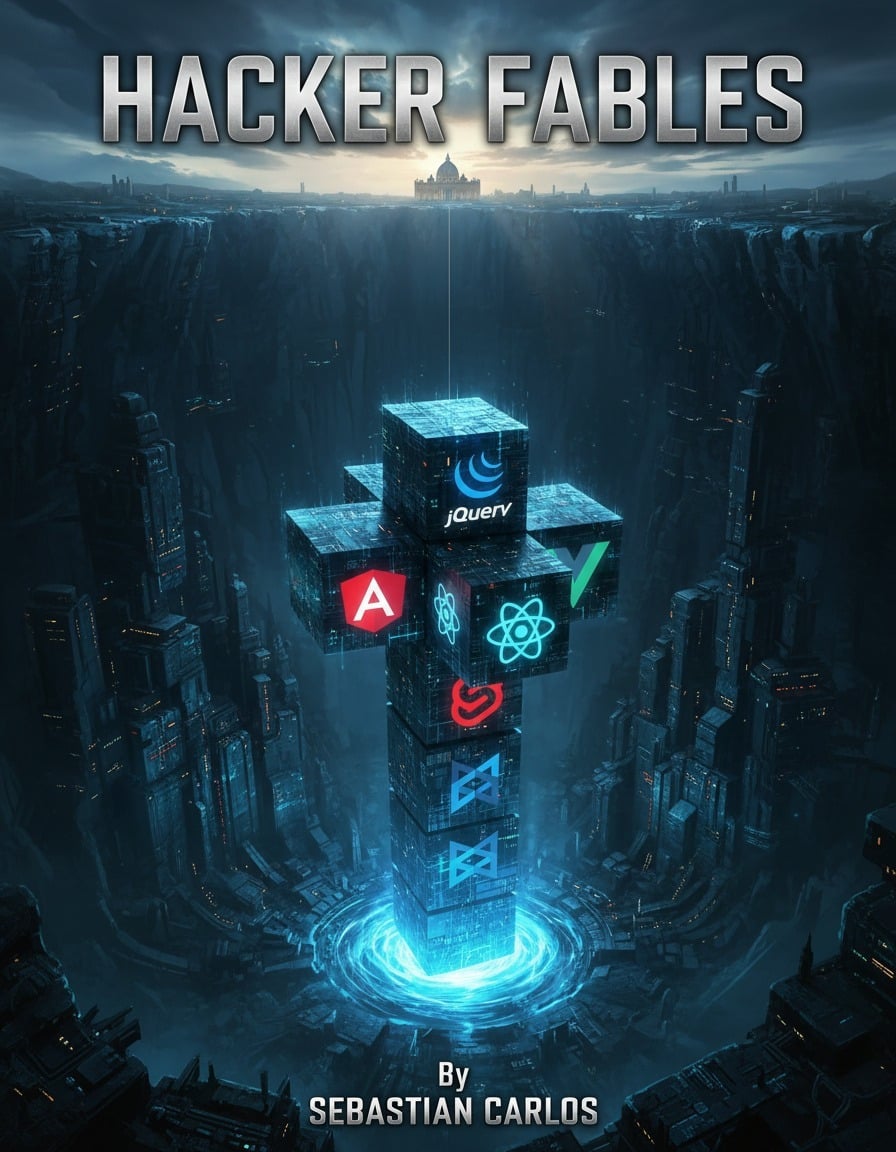
Hacker Fables
BY
Sebastian Carlos
2026
Blurbs
“Dan Brown on ketamine”
— The New York Times
“Neon Genesis Evangelion meets programming”
— The Guardian
“The world’s first LeetCode-Hard Sci-Fi Novel”
— LeetCode Weekly Digest
“If you think you’re a really good programmer, read Hacker Fables. You should definitely send me a résumé if you can read the whole thing.”
— Bill Gates
“A fitting swan song for the age of human programmers.”
— Sam Altman
Foreword
Sebastian Carlos is one of the greatest and most mysterious writers of our time.
I was amazed and honored that I was even on his RADAR. He was certainly the most unique writer I encountered on Medium. And he was popular, too, featured on ThePrimeTime and even coming on the ShlinkedIn discord.
I hope you appreciate Sebastian Carlos’ unique humor as much as I do. In an age where much of social media is dominated by the AI-generated, the corporate-shilling, and the cliche, Sebastian Carlos always has a creative and hilarious spin to put on the absurd nature of reality.
I would go as far as to call him the anti-slop: An antidote to all the AI-generated tech stuff that is so prevalent these days. If that stuff is bland and unsatisfying, Sebastian Carlos’ content will make you feel refreshed.
— Kurt S. Inu (@kurt.shibainu)
License
GNU FICTIONAL PUBLIC LICENSE VERSION 3
Copyright 2026 Sebastian Carlos
The author retains all rights over the associated document (the “LITERATURE”). It must not be copied using any existing or future technology such as: Morse code, microfilm, quantum entanglement.
However, permission is hereby granted, free of
charge, to any person obtaining a copy of this license to deal with
the license itself without restriction except for one: As this is a
“copyleft” license, every new copy of the license must undergo a
sed command to replace a randomly selected word with
“left.” If the license consists entirely of “left,” it can be used as
is, but an idempotent sed application is recommended for
symbolic compliance.
In case of live-action movie adaptation, the full text of the license shall be read out loud by Richard Stallman himself or any person declared worthy upon his demise.
Source code within the LITERATURE is provided “as is”, without warranty of any kind. This applies to dangerous software including but not limited to:
sudo rm -rf --no-preserve-root /Any real person mentioned in the LITERATURE constitutes fair use as satire. Nevertheless, the author invites any such persons to take legal action, as the fallout will only further promote the LITERATURE.
Privacy Policy
The key words “MUST”, “MUST NOT”, “REQUIRED”, “SHALL”, “SHALL NOT”, “SHOULD”, “SHOULD NOT”, “RECOMMENDED”, “MAY”, “CERTAINLY SO”, and “OPTIONAL” in this document are to be interpreted as described in RFC 2119.
However, only “MAY” is used, so you can ignore the rest.
You are reading a plain text file. It can’t track you.
But if you store it on a
GNU/Linux/systemd/FFmpeg system, it MAY track metadata such as
atime.
Page Intentionally Written in the Whitespace Programming Language
Part I
The Seven Keys
rfc-42666-parity-bit=0
rfc-42666-metadata=(:rarity high)
rfc-42666-id=(:malta-logs (:malta-project (lord (:of hosts)) :author (e (max (vim)))))
gnu-gpl-blockchain-metadata=(:content-type multipart-mixed :boundary part-one)
Chapter 1
Helsinki
My journey began in a place I never wanted to
git checkout again. A place where the man-made concept of
“day and night” loses its meaning. A place at the edge of a
flat-Earther’s world: Finland.
I’m E. Max Vim. This is the story of my most ambitious hack. Read along and you might learn something.
My first target was Oliver Salmiakki, a netsec professor at the University of Helsinki, where the music video for the hacker anthem, “Darude - Sandstorm”, was shot. Oliver was the only keyholder whose information was publicly listed — a fatal flaw.
My goal was to destroy DNS, the internet’s phonebook.
However, you can’t just hack a distributed system. The master key for the DNS root zone — the top of the pyramid — was its only weak spot. To protect the key, they split it into seven key shards held by seven individuals scattered across the globe.
They call them Trusted Community Representatives. I call them targets.
My motivations are complex, but it’s mostly revenge.
Oliver and I have some history. It involved a JavaScript conference and his then-girlfriend, who apparently found my explanation of Vim’s modal editing compelling. I was drunk, she was drunk, and frankly, nothing that happens at a JavaScript conference should be taken seriously — Oliver, however, took it personally.
I slipped into the back of the lecture hall. It was a sea of MacBooks, most of them displaying a random California mountain wallpaper. Their hue perfectly matching the time of day thanks to NTP — a triumph of network timekeeping involving distant pulsar stars just for a cheap trick. Yet I admit it blended pleasantly with the natural light.
My sensory organs panned to the stage. Oliver was talking about quicksort. I waited for a pause, then cleared my throat.
“Professor,” I said. “Your quicksort example is missing tail calls. Is this supposed to be a retro computing class?”
Keyboards stopped clacking. Oliver froze, chalk dust settling around him like Perlin noise. His eyes behind thick glasses locked onto mine. A moment of recognition, then pure fury.
He addressed his students. “Class dismissed. Please ensure your commits are pushed before leaving. We appear to have encountered… legacy code.”
As they left, grateful for the break, Oliver adjusted his tweed jacket. “E. Max Vim. How dare you soil the land of Linus Torvalds with your presence?” he hissed, pulling a custom-made shuriken shaped like the Linux penguin mascot from his coat.
With a flick, he sent Tux flying. It wasn’t aimed at me — not yet. It embedded itself into the stereo system. The ambient track cut out, replaced by Darude’s “Sandstorm” at full volume.
“Predictable,” I sighed, pulling out two identical Nokia 3310s, one in each hand, connected by a USB cable like improvised nunchucks. Indestructible. Reliable.
To become a hacker in our brave new world, reading books is not enough. You also need to master two physical skills: Vim keybindings, and martial arts. Oliver, like all DNS keyholders, was proficient in both.
Luckily, I had been trained by the very best. Months of excruciating training by Sensei Richard Stallman had prepared me for this moment. It was time to put my skills to the test.
“Nokia nunchucks?” Oliver sneered. “You’re not going to pull out your open-source katana?”
“My katana is reserved for worthy opponents,” I replied. “If you really want it, you’ll have to build it from source… from hell!”
“There’s ChaCha20 encryption on my key,” Oliver said unfazed. “Military-grade. You won’t decrypt it.”
“I don’t want to decrypt the key, Oliver,” I replied, advancing with the pounding beat. “I want to destroy it.” I swung the Nokias menacingly. “Now, let’s dance some cha-cha-cha.”
The fight was brutal, clumsy, and punctuated by the relentless dun dun dun Eurobeat. Chairs splintered against the wall. Expensive Scandinavian vases shattered.
Oliver kept his distance, so I prepared a
“visual mode” Vim macro — qavapq — and eyeballed the
count prefix that would bring me into melee range. Any
overestimation would crash me into the wall at TUI-editor speed.
5@a did the trick, and brought me close enough to disable
his shuriken and corner him against a bookshelf.
Out of options, he grabbed a heavy textbook, “The Art of Computer Programming, Volume 3: Sorting and Searching.”
Luckily, my quick jab with the corner of a Nokia connected first. His Knuth punch lost momentum by the time it hit my head, leaving me with just a mild concussion.
His terminal emulator, however, closed
permanently. SIGTERM.
I retrieved the key shard, stored on a USB stick around his neck.
Thanks to Finland’s perpetual twilight and an efficient public transport system running on Erlang, my escape was clean.
Before leaving the country, I found a traditional wooden sauna. I placed the USB stick on the hot rocks. The plastic warped, smoked, and the silicon cracked.
One key down.
Chapter 2
Silicon Valley
$ cat ~/kill-dns-list.txt
# Key 1
Location: Helsinki
Keyholder: Oliver Salmiakki (dead)
Status: Destroyed

# Keys 2-7
Location: ???
Keyholder: ???
Status: Secure
I used to be a corporate programmer, dreaming of elegant systems, but my ethical projects got shot down one too many times. I realized the entire structure had to be torn down to build anything meaningful.
My mission: Liberate the internet from this centralized cabal. Return the web to its primordial, free state.
The DNS master key is reforged on the first full moon every year, during a highly secure “Key Ceremony.”
At least five of the seven key shards must be present. Otherwise, the entire DNS system collapses. With only six keyholders left, my goal was within reach.
Word quickly spread of my exploit in Helsinki. This notoriety led me, ironically, to the heart of the beast: Silicon Valley.
The streets of Palo Alto were populated by gangs wearing Emacs colors, singing old-school text-editor anthems. It must be an Emacs holiday today.
I covered my Vim logo as I made my way to the open-plan, cocaine-fueled office of Linktree, a company whose entire business model seemed to answer the question no one asked: “What if a tree… of links?”
Their CEO, Zackaria “Zack” Jones, was a man whose personality was A/B tested for maximum engagement.
“Max, my man! Disruptor! Paradigm shifter!” Zack greeted me with a fist bump that felt worryingly sincere. He wore Yeezys and a t-shirt that ironically said “Decentralize Everything.” “Love your work. Big fan of chaos! Murder! We need more of that energy. Helsinki? Masterpiece.”
His plan was even more megalomaniacal than mine. He didn’t just want to break DNS; he wanted to build something new on top of the ruins. He wanted to replace HTTP (HyperText Transfer Protocol) with his proprietary LTTP (LinkTree Transfer Protocol). It was brilliantly horrifying.
To the untrained eye, a website ends in
.com. The hacker knows there’s a hidden final dot, followed
by the ineffable force around us, the “DNS root zone”. If Zack succeeds,
his mark will be on full display: .com.linktree.
“We can help each other, Max.” Zack gestured expansively. “I know the location of all remaining DNS keyholders. You take down the old guard, clear the field. I build the new guard.” He saw me as the perfect tool: motivated, capable, someone primed for destruction.
I wasn’t thrilled about his plan, but I was confident it would fail faster than a Series D startup. For now, our paths aligned, and I needed his intel.
It was then that she walked in. Tall, dressed head-to-toe in black latex that squeaked with every move. Her hair pulled back into an architectural bun. Her cheekbones looked sharper than inline assembly. Her eyes held the cold look of someone who could DDoS a small nation.
“Natasha Volkov,” Zack introduced her. “Our Head of Risk Mitigation.”
Natasha eyed me up, her gaze lingering perhaps too long on the minimalist Vim logo on my black hoodie. She crossed her arms, the latex on her hand stretched, revealing the outline of a heavy ring.
“Zackaria seems to trust you,” she stated with a thick Russian accent. “I don’t.”
“Haha, priceless!” Zack laughed. “Gotta love that Eastern European humor.”
“Anyway!” He continued. “I’m a CEO, not a mathematician, but let’s run the numbers: Seven keyholders total. You took out one in Helsinki. Quorum requires five keys, right? So, you need to take down… two more, and the whole thing collapses.” He smiled, proud of his calculation.
His math was surprisingly correct. He might be sharper than most CEOs.
“Alright, disruptor, let’s do this!” He turned to Natasha. “Give Max the coordinates for the two closest keyholders.”
Chapter 3
Buenos Aires
$ cat ~/kill-dns-list.txt
# Key 1
Location: Helsinki
Keyholder: Oliver Salmiakki (dead)
Status: Destroyed

# Key 2
Location: Buenos Aires
Keyholder: "Evita" Rosales
Status: Secure

# Key 3
Location: Buenos Aires
Keyholder: "El Pelado" Gomez
Status: Secure

# Keys 4-7
Location: ???
Keyholder: ???
Status: Secure
The intel pointed to an unlikely convergence — two keyholders in Buenos Aires, Argentina. Bad security practice.
Eva “Evita” Rosales, a former tango dancer turned libertarian cryptographer. Ricardo “El Pelado” Gomez, a chain-smoking security consultant.
They were meeting at La Catedral, a cavernous tango club in the Almagro neighborhood — a place filled with mournful accordion music.
I arrived as Piazzolla melodies filled the air. I made my way through the dancing couples.
As an IT person, my facial recognition skills aren’t great — not to mention Argentinians look like the output of a diffusion model fed with every soccer player in the world — so my targets were hard to spot.
Luckily, I heard some flirtatious tech talk from a couple of tables away.
“I ran nmap with a subnet mask,”
Evita said. “It detected my laptop and my phone, but also some
mysterious IPs that came from inside the house, some
192.168 kinda shit.”
“So, what did you do?” El Pelado asked.
“Well, I rolled up my sleeves, enabled
‘promiscuous mode’, and tcpdumped that shit right into the
wireshark, if you catch my drift. I analyzed all the
packets. The MAC address manufacturer was ‘Sepura Limited’, which was
promptly added to my block-list.”
El Pelado made a deep sigh and whispered, “The panopticon isn’t metaphorical.”
“Your key shards,” I stated, catching them by surprise. “Hand them over.”
El Pelado sighed, smoke coming out of his nostrils. “Always drama with you yankee hackers.”
The fight began without further preamble.
Evita fought using tango steps. As I was desperately parrying her with my Nokias, El Pelado’s ThinkPad T400 struck me before I could edit myself out of the blast radius, sending me sprawling.
“Didn’t you hear?” he growled. “It takes two to tango!”
As I got up, I noticed the laptop did a number on my ribs. I had been hit by ThinkPads before - part of Sensei Richard Stallman’s training - but this one felt particularly strong, likely reinforced with military-grade titanium.
I was barely keeping up thanks to desperate
Vim evasive maneuvers (dd to dodge, u to
retreat). All the Prolog code I’d written for soulless FAANGs flashed
before my eyes — lines of pure logic that led to this moment.
Just as they had me cornered, a flash of black latex passed by. Natasha.
She wrapped her legs around the cryptographer’s neck in a complex Foot Jiu-jitsu choke — an advanced technique which Stallman was unwilling to teach me. Then she dispatched El Pelado with equal ease.
Their terminals closed for good.
SIGKILL.
Natasha walked over calmly, retrieved Evita’s USB shard from a hidden pocket in her velvet dress, dropped it on the floor, and shattered it under her heel. She located El Pelado’s shard among the debris and gave it the same treatment.
“Zackaria warned me you might require assistance,” Natasha said coldly over the returning tango music. “He was correct.”
“Three keys down,” I said, catching my breath. “The quorum is broken. We’ve beaten DNS.”
“We won’t know for sure until the next Key Ceremony,” she replied. “Are you ready to stop your killing spree? What if the other keyholders broke protocol and have some sort of backup? Zackaria expects results in Berlin next.”
She handed me a USB with the location of another keyholder. She paused, her eyes meeting mine with intensity. “See that you don’t disappoint my expectations.”
She turned away. “Natasha,” I called. “Are you coming to Berlin?”
She looked back. “An unfortunate incident prevents me from entering the complex. Berghain has a strict entry policy — you’ll be fine.”
I had a bad feeling about Berlin, and a growing suspicion about Natasha’s true allegiance.
Chapter 4
Berlin
$ cat ~/kill-dns-list.txt
# Key 1
Location: Helsinki
Keyholder: Oliver Salmiakki (dead)
Status: Destroyed

# Key 2
Location: Buenos Aires
Keyholder: "Evita" Rosales (dead)
Status: Destroyed

# Key 3
Location: Buenos Aires
Keyholder: "El Pelado" Gomez (dead)
Status: Destroyed

# Key 4
Location: Berlin
Keyholder: Jürgen Schmidt
Status: Secure

# Keys 5-7
Location: ???
Keyholder: ???
Status: Secure
Berghain — The techno temple. The concrete cathedral of hedonism. My target, Jürgen Schmidt, wasn’t just a DNS keyholder; he was the club owner.
Finding him meant descending into the club’s depths — the unequivocal heart of darkness of our decadent world.
Gaining entry past the bouncer required
hacking their opaque door policy — a feat involving social engineering,
analysis of historical entry data with matplotlib, and
finally, dark clothes and a bored expression on my face.
My open-source katana, badly needed after my performance in Buenos Aires, was confiscated at the door.
The descent was educational. Each level plunged deeper into avant-garde sexuality, industrial aesthetics, and the limits of the Fast Fourier Transform’s usage in music. By Level 5, I felt like I’d stumbled into a Hieronymus Bosch painting.
Finally, Level 6. The air hummed with a subsonic bassline that made my bones vibrate. The only light came from a single, ultraviolet neon portrait of Michel Foucault hanging on the concrete wall.
The scenes unfolding… Well, let’s just say practices were occurring that probably won’t hit the mainstream for another 30 years, if ever.
Suddenly, the pounding 132bpm techno track lowered its tempo, fading into a single bass drum beat. A white spotlight snapped on, illuminating me at the center of the vast room. From a balcony, a figure emerged — Jürgen.
“Looks like ve haff a visitor who did not respect ze Hausordnung,” his voice a high-pitched, cartoonish Bavarian accent cutting through the beat. The denizens of Level 6 paused their activities, turning towards me.
“Ah, an Anglo-hacker,” he continued, looking with contempt. “You cannot possibly comprehend what ve are doing here. Ze German language, with its declensions and cases, is a compiler unto itzelf. You come here and mean to defy us? You think you can out-hack us and take unsere DNS key?”
Jürgen dramatically threw off his silk robe, revealing an oiled and surprisingly muscular physique for a man presumably subsisting on club drugs. And next to his original, fully erect penis, was another one. Identical. Bio-engineered, apparently. He struck a pose.
“Vhat’s ze problem, mein Freund?” he sneered. “Too much sexual deconstruction for your hacker sensibilities?”
I admit, I was momentarily thrown. Not by the dual genitalia — I’d seen weirder things in Perl scripts — but by the sheer, weaponized postmodernism of it all. I glanced at Foucault, seeking philosophical guidance. Inspiration struck.
“The only thing getting deconstructed tonight is your neck,” I snarked, reaching up and yanking the surprisingly heavy neon Foucault portrait off the wall with a grunt. Using it like a boomerang, I threw it across the room. It connected with the head of a henchman, who went down hard.
“Dee Jay… drop einen Beat! Hu-hu-hu!” Jürgen laughed, unconcerned.
The music kicked back into high gear and the room erupted in combat. Strobe lights pulsed, turning the brawl into a series of freeze-frames.
Jürgen, surprisingly agile for a man packing twice the usual heat, front-flipped towards me, swinging a chrome-plated butt plug the size of a traffic cone.
It was a blur of leather, sweat, poppers, blood, and questionable body fluids. I blocked a blow from a girl wearing tape crosses on her breasts and a plague doctor mask. I threw her into a suspiciously bubbling jacuzzi.
Finally, I faced Jürgen, swinging the bludgeon. I sidestepped, grabbed a bottle of poppers from a nearby table and, in a moment of improvisation, squeezed the entire contents directly into his left eye socket.
His scream was primal. Visceral. So raw that — I later heard — snippets of it were sampled by three different Berlin techno producers and became underground hits.
Jürgen collapsed. EPIPE (Broken
pipe).
I straightened my hoodie, now covered with blood and several other substances I didn’t want to identify, and walked back up towards the exit. The Garderobe twink handed me back the katana with an apathetic nod.
Nobody gave me a second glance. The massacre on Level 6 apparently didn’t amount to much more than a typical Friday night at Berghain.
Four keys down.
Chapter 5
Brandenburg
$ cat ~/kill-dns-list.txt
# Key 1
Location: Helsinki
Keyholder: Oliver Salmiakki (dead)
Status: Destroyed

# Key 2
Location: Buenos Aires
Keyholder: "Evita" Rosales (dead)
Status: Destroyed

# Key 3
Location: Buenos Aires
Keyholder: "El Pelado" Gomez (dead)
Status: Destroyed

# Key 4
Location: Berlin
Keyholder: Jürgen Schmidt (dead)
Status: Destroyed

# Keys 5-7
Location: ???
Keyholder: ???
Status: Secure
The flight back from Berlin wasn’t commercial. Zack insisted I use his private jet.
I was drinking a glass of something expensive, feeling a sense of accomplishment. Four keyholders down, more than enough to ensure the downfall of DNS.
“Max, my dude! Crushing it!” Zack said enthusiastically.
Beside him stood two unexpected figures: Ren Zhengfei, the CEO of Huawei, wearing a tailored suit, and Bob Sternfels, the CEO of McKinsey, whose eyes radiated spreadsheet energy. Natasha stood silently in the background — her expression suspiciously unreadable behind dark sunglasses, despite being indoors at 40,000 feet.
Almost instantly, the edges of my vision began to look like a Gaussian blur. The cabin walls flickered and distorted for a second. Zack’s white smile became predatory.
“Whoa,” I slurred, feeling my limbs turn to jelly.
“We gave you just a little something to ensure strategic alignment,” Zack said, his voice losing its tech-bro warmth.
My heart sank. Drugged. On a private jet. Surrounded by oligarchs — classic blunder.
I’d been on ketamine before, so I knew the phenomenological drill of hard drugs hitting my neuroreceptors. This substance was stronger, but I hoped the adrenaline of the situation would keep me alert.
“You’ve been a useful agent,” Zack continued. “Upper-management material. But your understanding of the endgame was flawed. You thought this was about breaking DNS?” Zack laughed. “Cute. So Web 2.0. No, Max. This was always a hostile takeover.”
He gestured towards Ren and Bob. “Let me introduce two keyholders you haven’t met. They’ve been partners in my scheme from the very beginning. By the time you met me, I was already in possession of all the needed keys.”
“But…” I managed to say. “You need five. There are only three keys left.”
“You still don’t get it,” Zack said. “Ren and Bob have two keys. The two Argentinian keys have been compromised since the late ’90s. All software in Argentina has a backdoor, put there during the Falklands War. State-sponsored stuff — the only way to do safe computing in Argentina is inside a Faraday cage.”
He leaned closer. “Jürgen in Berlin, an associate of mine, had the fifth key — Yes, you killing him was inconvenient. Natasha’s little stunt trying to sabotage me, I assume.” He glared momentarily at Natasha, who was startled by two henchmen drawing guns at her.
Her eyes met mine briefly with calculation — maybe Zack’s protocol-level ambitions had finally crossed a line even for her.
“But that was ultimately irrelevant,” he continued. “Jürgen himself sent me a copy months ago via RFC 1149 carrier pigeons. So, that makes five — ready for the Key Ceremony at the next full moon.”
“You just helped me handle the loose ends who weren’t in my pocket. Now I’ll handle the remaining ones,” he continued. “The keyholder in Dubai, and you.”
The betrayal hit harder than the drugs. He was playing 5D Chess, and I was just a pawn.
“You might not see it now, Max, but we’re on the same side. We’re both tech people,” he said with some sincerity. “The tech world needs strong leadership. Otherwise we’re conceding defeat to the older powers in Rome and Washington.”
The only skill fully preserved under drugs is that of first-order logic. From that framework, his argument was sound. Yet, a more subtle, heuristic part of my psyche gave me a bad gut feeling that I couldn’t formalize, but I decided to trust it.
“Now, Max,” Zack leaned in again, raising a 3D-printed gun. “Just one little security check. Standard procedure. We need to be sure you didn’t keep any souvenirs.” He handed me my laptop. “Unlock your ThinkPad, let my tech guys check your drive.”
My mind raced. Giving them access was unthinkable. My logs, my contacts, the live screen feed of my wife’s phone, my half-finished novel.
Then, a bizarre memory surfaced, a particularly odd training session by Sensei Richard Stallman.
“Max,” Stallman said, “freedom requires not only free software, but free thought!” He pointed to an ancient CRT monitor displaying grainy footage from a popular 90s sitcom.
On screen, Chandler was talking to Monica. But the audio was wrong. It was “Friends” dubbed in ROT13, or as I recall, “Sevraqf.” ROT13 is a cipher where each letter is shifted 13 places down the alphabet.
“Watch. Learn. Internalize the cadence!”
We’d spent weeks watching ROT13 “Friends” reruns. He insisted it was crucial training for communicating in hostile environments. It seemed pointless at the time — until this very moment.
“Fine. You win,” I slurred. “Set the keyboard to the Colemak layout and I’ll type the password.”
I typed carefully. Not my actual password, but its ROT13 equivalent, which triggered an almost forgotten subroutine.
The login screen flickered for a moment. Zack leaned closer, impatient. Then, small panels opened on the sides of the bulky ThinkPad — hardware modifications I added during a particularly paranoid phase.
With a series of pfft sounds, dozens of miniature tranquilizer darts shot out in all directions.
Zack yelped, clutching his neck where the dart embedded. Ren and Bob got hit too. Natasha took the chance to kick the guns from the henchmen’s hands.
“Traitor!” Zack screamed, fumbling with his gun as the toxin began to take hold. He fired. Bullets ricocheted off the cabin walls.
Natasha pulled the “Emergency Exit” handle. The cabin depressurized instantly. She grabbed my arm, pulling me towards the hole.
“Hey!” Ren shouted. “You can’t do this to Huawei!”
“Nothing personal, Ren!” I shouted back over the hurricane-winds. “But it’s Huawei or the highway!”
We jumped.
Our landing was soft, cushioned by an improbably large, rain-soaked pile of Alternative für Deutschland (AfD) election posters dumped in a rural Brandenburg town. Classy.
There were three Nazis standing on the hill, looking disappointed because we looked too white to beat up.
The grim reality settled in. Zack’s plan was perfectly viable.
“It’s over,” I said, looking at the pile of nationalistic propaganda. “They won.”
“They won for now, but we are playing the long game,” Natasha corrected. For some reason, I felt her “we” was hiding something.
“There’s one wildcard left,” she added. “Let’s go to Dubai.”
Chapter 6
Dubai
$ cat ~/kill-dns-list.txt
# Key 1
Location: Helsinki
Keyholder: Oliver Salmiakki (dead)
Status: Destroyed

# Key 2
Location: Buenos Aires
Keyholder: "Evita" Rosales (dead)
Status: Compromised

# Key 3
Location: Buenos Aires
Keyholder: "El Pelado" Gomez (dead)
Status: Compromised

# Key 4
Location: Berlin
Keyholder: Jürgen Schmidt (dead)
Status: Compromised

# Key 5
Location: ???
Keyholder: Ren Zhengfei
Status: Compromised

# Key 6
Location: ???
Keyholder: Bob Sternfels
Status: Compromised

# Key 7
Location: Dubai
Keyholder: Mohamed Al-Farsi
Status: ???
Dubai, here goes nothing. The final keyholder — the last, desperate chance to stop Linktree.
As we moved through Ramadan tents, I got to know Natasha. At first she didn’t think Zack would achieve his LTTP goals, but noticing how close he was with some keyholders, she began to worry. Her Belarusian background made her adept at recognizing megalomaniacs by their weird haircuts.
In Buenos Aires, she gave me the location of Jürgen without Zack’s knowledge, as a way to disrupt his plan. Now, the situation had become dire, and our only hope was to meet the final keyholder.
Mohamed Al-Farsi, known for his expertise and his paranoid security measures, hadn’t been seen in public in years. But our intel pointed to a data center in Dubai Production City.
We arrived at the complex gates. It was Friday, which meant the security would be lax during the noon prayer — the perfect time to sneak in.
But the task was far from easy, as it was guarded by biometric scanners, laser grids, and a room full of pressure plates representing a game of Minesweeper that we had to beat to open the final door. At the end, Natasha held two pressure plates down to bypass an ambiguous bomb location, leaving me to proceed alone and face Mohamed.
I found him in a minimalist prayer room adorned with calligraphic art, next to the main server. The hum of cooling systems was coming through the walls, made visible under the shafts of light from a moon-shaped window.
He finished his prayer, slowly rose, and turned towards me. His eyes showed no surprise.
“So, the ghost in the machine arrives,” he said softly. “The one they call E. Max Vim. You have caused disruption across the network, and geopolitical instability.”
“Just balancing the parentheses, Mohamed,” I replied.
“Hmm… It’s curious you mention Lisp in this sacred space; that language is more venerable than you think,” he said gently. “You seek my key?”
“Well, I’ll make it short,” I said, meeting his gaze. “A corporate cabal led by Zack Jones is about to seize control of DNS. They plan to replace it with a proprietary system.”
He nodded slowly, adjusting his glasses. “Zackaria Jones… LinkTree Transfer Protocol… Yes, I’ve seen the network chatter. The arrogance. The patterns are emerging. And now you want me to help destroy DNS, unleash chaos to prevent tyranny.”
He continued. “A tempting philosophy, yours. One I have wrestled with myself. But chaos is not freedom. It is merely a different kind of tyranny — the tyranny of the strong preying on the weak without the pretense of rules.”
He stood up fully, adjusting his black thobe. “DNS is protected. Not merely by encryption, which is fallible. It is quantum-entangled with my own life. A dead man’s switch.”
“Did you say quantum-entangled?”
“Ah, yes. You see, I worked for the NSA. Their quantum tech is decades ahead of public knowledge. I foresaw the need to protect DNS from something like this, so I created the ultimate backdoor.”
He looked at me. “You must know that if I die — outside of specific protocols — the mechanism doesn’t just erase my shard’s data, but the entire DNS.” His voice dropped slightly. “It’s designed to inject garbage into the very heart of the system during any subsequent Key Ceremony. It will brick DNS at a fundamental level.”
Understanding dawned in his eyes. “You wish for me to trigger the fail-safe by my death. To ensure that no one — not ICANN, and certainly not Zack — can control DNS ever again. A final, destructive act of decentralization.”
He looked up, and an uneasy peace settled over him. “Perhaps chaos is preferable to that tyranny after all. The system we built was flawed from the start. Too much trust placed in too few hands, vulnerable to human greed.” He looked at the calligraphy on the wall, then back at me, his decision made. “Perhaps it is time for it to end. For something new to emerge from the ruins.”
“You might think this is the end of your quest, E. Max Vim, but I sense far bigger challenges ahead of you.” He spread his hands slightly, palms open. “Very well. Do what you must. Trigger the reset. Make it clean.”
I raised my open-source katana. My hand was steady. This wasn’t revenge anymore. It was the only way to stop Zack. It felt necessary — a system reset.
A single hit, clean and precise. Mohamed fell
without a sound onto the prayer rug. sudo kill.
I looked at the intricate calligraphy on the wall, depicting verses about knowledge and truth. An unexpected pang — not remorse, exactly, but respect. Respect for the man who built a self-destruct button into the heart of the internet and, when the time came, had the conviction to see it pushed.
He was a better hacker than me. Perhaps if I’d worked alongside people like him instead of corporate drones, I wouldn’t have ended up on this solitary path. But then again, no FAANG would put two competent programmers on the same team; too much of a risk.
“Peace be upon you, brother of the book,” I murmured, as pious as I could as an Ahl al-Kitāb, feeling the weight of my actions settle upon me.
I wiped the blade clean on my sleeve and placed it gently on the floor beside him, its edge facing away. It was the only worthy offering that couldn’t be linked back to me. Its UUID number, unlike that of pre-built katanas, was untraceable.
Outside, Natasha would be dealing with the pressure plates — time to leave.
The quantum fail-safe triggered by Mohamed’s death propagated at the speed of entanglement, ready to poison the next signing attempt.
Chaos unleashed. Coup averted.
Chapter 7
Malta
$ cat ~/kill-dns-list.txt
# Key 1
Location: Helsinki
Keyholder: Oliver Salmiakki (dead)
Status: Deactivated (?)

# Key 2
Location: Buenos Aires
Keyholder: "Evita" Rosales (dead)
Status: Deactivated (?)

# Key 3
Location: Buenos Aires
Keyholder: "El Pelado" Gomez (dead)
Status: Deactivated (?)

# Key 4
Location: Berlin
Keyholder: Jürgen Schmidt (dead)
Status: Deactivated (?)

# Key 5
Location: ???
Keyholder: Ren Zhengfei
Status: Deactivated (?)

# Key 6
Location: ???
Keyholder: Bob Sternfels
Status: Deactivated (?)

# Key 7
Location: Dubai
Keyholder: Mohamed Al-Farsi (dead)
Status: Deactivated (?)
So, that’s the story.
Natasha and I parted ways on a dusty airstrip on the isle of Malta. She said something vague about “working on experimental tech” and that she would contact me when the time was right.
The warm weather made her take off her latex gloves. As I shook her hand, I noticed a Latin phrase tattooed on her finger, “Deus Vult · Compilamus,” next to a nobility ring showing an eight-pointed Maltese cross.
“You did what had to be done,” Natasha said. “Better DNS dies free than gets bought. Like JavaScript.”
I gave her a look, but she was already turning away, pulling her gloves back on. “Safe travels, Vim.”
Our alliance, born of shared enemies, dissolved as quickly as it formed. But I had the feeling our paths would cross again.
Before vanishing myself, I set up my own dead man’s switch. A simple bash script, really. Wired to trigger this transmission to a few pre-selected, resilient corners of the old internet — Usenet — if my vitals flatline.
This message was triggered either by my death, or because the very disruption I unleashed caused worldwide decryption and data leakage.
Keep an eye on your DNS resolution times for the next few days. If things start getting weird, you’ll know why.
The full consequences? Hard to predict. Catastrophe? A temporary outage? A slow degradation?
The future of the network is unwritten. Choose your resolvers wisely.
If this message is sent, my private logs will also be decrypted and released.
Be warned: My logs are chaotic like my mind. But if you connect the dots, it will all make sense in the end.
E. Max Vim, signing off.
END OF FILE

VERIFYING e-max-vim-part-00.log
VERIFICATION SUCCESSFUL!
> exit code: 0
Part II
Hacker Fables
rfc-42666-parity-bit=0
rfc-42666-metadata=(:rarity high)
rfc-42666-id=(:malta-logs (:malta-project enoch :background-check-for (e (max (vim)))))
gnu-gpl-blockchain-metadata=(:content-type multipart-mixed :boundary part-two)
The following fragments are the decrypted logs of E. Max Vim. They are presented not in chronological order (an unambiguous chronological order is hard to establish) but in their original order, which should help validate the cryptographic signature (readers can replicate it on their system if GnuPG is up to date and correctly configured).
DECRYPTING e-max-vim-logs.tar...

$ gpg --decrypt --output e-max-vim-logs.tar e-max-vim-logs.tar.asc
gpg: enabled "Great DNS Heist of 2026" compatibility flag (RFC 9987)
gpg: AES256.CFB encrypted data
gpg: encrypted with 1 passphrase
gpg:    passphrase leaked through "Great DNS Heist of 2026"
gpg:    source: https://dns-heist-db.openpgp.org

DECRYPTION SUCCESSFUL!

EXTRACTING LOGS...

$ tar -xvf e-max-vim-logs.tar
x e-max-vim-part-00.log
x e-max-vim-part-01.log
x e-max-vim-part-02.log
x e-max-vim-part-03.log
x e-max-vim-part-04.log
x e-max-vim-part-05.log
x e-max-vim-part-06.log
x e-max-vim-part-07.log
x e-max-vim-part-⸮⸮.log
x e-max-vim-part-09.log

EXTRACTION COMPLETE!
SHOWING LOGS, PART 1...
$ cat e-max-vim-part-01.logChapter 1
Meta
I wasn’t born a hacker. Life made me one. I was once a corporate programmer. Here’s the story of my first and only FAANG job. Its aftermath put me squarely on the hacker path.
This is not a rant from a disgruntled ex-employee. These are the raw facts. I won’t shy away from the serious corporate espionage or the ethical dilemmas I faced during my brief tenure at Meta.
I’m not proud of everything I did. I used to think of myself as an idealistic tech enthusiast, but Meta has a way of bringing the worst out of people.
Considering they fired me for telling some truths, I figured I should write my side of the story, in case I felt like making it public one day.
Besides, their legal team can’t touch me — I checked with my lawyer and my compiler. My logic is sound. More on that later.
I prepared for the interview frantically, refreshing my knowledge of all the trendy Silicon Valley buzzwords like “quantum” and “default mode network.”
The algorithm question was a bit silly — something only a trendy FAANG company could propose with a straight face: “Write a program that generates text like the lyrics of ‘Girls and Boys’ by Blur and outputs a chain of ‘X who likes Y who likes Z’ up to an arbitrary depth.”
Girls who want boys
Who like boys to be girls
Who do boys like they’re girls
Who do girls like they’re boys
— “Girls and Boys,” Blur, 1994
It seemed surprisingly tailored to a Prolog implementation. Defining a few logical relations would provide far more functionality than initially asked for, thanks to Prolog’s math-powered backtracking algorithm.
I weighed the risk of being considered a snob, but went ahead and asked to use Prolog.
The interviewer seemed pleasantly surprised, almost eager to give me the job on the spot. He actually knew someone on that floor who was a Prolog expert.
Five minutes later, a tech bro walked in, half his shirt untucked and wearing a pair of Ray-Bans. My interviewer introduced him as Chad Thunderman, the Prolog expert. He left us alone so Chad could properly assess my skills.
At first, I tackled the problem myself. The algorithm was tricky but nothing I couldn’t handle.
From memory, I think my code looked something like this:
#!/usr/bin/env swipl --quiet

:- use_module(library(clpfd)).

% ORIGINAL LYRICS:
% Looking for
% Girls who want boys
% Who like boys to be girls
% Who do boys like they're girls
% Who do girls like they're boys
% Always should be someone you really love
% - "Girls and Boys," Blur, 1994

% DSL CONVERSION:
% girls who like boys
% who like boys (who are girls)
% who like boys (who get done like they're girls)
% who like girls (who get done like they're boys)

% TREE STRUCTURE:
% group(female, none, none, group(
% male, female, none, group(
% male, none, female, group(
% female, none, male, none)))).

% USAGE:
% 1. Get all possible lyrics up to a max depth:
% ?- group_maxdepth(G, 4), group_string(G, S).
% 2. Get the tree structure of some lyrics (pass a max depth to avoid unbounded recursion):
% ?- group_maxdepth(G, 4), group_string(G, 'boys who like girls').
% 3. Get the lyrics from a tree structure:
% ?- group_string(group(male, none, none, group(female, none, none, none)), S).
% 4. Fill in the blanks with all possibilities:
% ?- group_depth(G, 3),
% phrase(group_sentence(G), Tokens),
% append([[girls, who, like], X, [who, like], Y], Tokens),
% atomic_list_concat(Tokens, ' ', S).

% Genders
gender(male).
gender(female).

% gender_altgender(G, G2)
% Valid relation between gender and alternative genders (isGender and
% PerformGender) in the same group.
gender_altgender(G, none) :-
gender(G).
gender_altgender(G, G2) :-
gender(G),
gender(G2),
dif(G, G2).

% Group(Gender, IsGender, PerformGender, LikeGroup).
% All arguments but Gender are optional.
% Represents a demographic that can like and can be a target of liking.
group(Gender, IsGender, PerformGender, none) :-
gender(Gender),
gender_altgender(Gender, IsGender),
gender_altgender(Gender, PerformGender).
group(Gender, IsGender, PerformGender, group(Gender2, IsGender2, PerformGender2, Group)) :-
group(Gender, IsGender, PerformGender, none),
group(Gender2, IsGender2, PerformGender2, Group).

% DCG to produce a phrase from a group.
% Example:
% ?- phrase(group_sentence(group(male, none, none, group(female, none, none, group(male, none, none, group(male))))), Tokens).
% Tokens = [boys, who, like, girls, who, like, boys, who, like, boys].
group_sentence(group(Gender, IsGender, PerformGender, none)) -->
{ group(Gender, IsGender, PerformGender, none) },
gender_phrase(Gender),
group_info_phrase(IsGender, PerformGender).
group_sentence(group(Gender, IsGender, PerformGender, Group)) -->
{ dif(Group, none) },
group_sentence(group(Gender, IsGender, PerformGender, none)),
[who, like],
group_sentence(Group).

gender_phrase(male) --> [boys].
gender_phrase(female) --> [girls].

isgender_phrase(none) --> [].
isgender_phrase(Gender) --> [are], gender_phrase(Gender).

performgender_phrase(none) --> [].
performgender_phrase(Gender) --> [get, done, like, 'they''re'], gender_phrase(Gender).

% Render isGender and PerformGender within parentheses.
group_info_phrase(none, none) --> [].
group_info_phrase(IsGender, none) -->
{ dif(IsGender, none) },
['(', who], isgender_phrase(IsGender), [')'].
group_info_phrase(none, PerformGender) -->
{ dif(PerformGender, none) },
['(', who], performgender_phrase(PerformGender), [')'].
group_info_phrase(IsGender, PerformGender) -->
{ dif(IsGender, none), dif(PerformGender, none) },
['(', who], isgender_phrase(IsGender), ['and'], performgender_phrase(PerformGender), [')'].

% Relate group and string representation
% ?- group_string(group(male, none, none, group(female, none, none, group(male, none, none, group(male)))), S).
% S = 'boys who like girls who like boys who like boys'
group_string(group(Gender, IsGender, PerformGender, Group), String) :-
phrase(group_sentence(group(Gender, IsGender, PerformGender, Group)), Tokens),
atomic_list_concat(Tokens, ' ', String).

% Relate group and depth
% - group(G0, IG, PG, none) has depth 0
% - group(G0, IG, PG, group(...)) has depth 1
group_depth(group(Gender, IsGender, PerformGender, none), 0) :-
group(Gender, IsGender, PerformGender, none).
group_depth(group(Gender, IsGender, PerformGender, Group), Depth) :-
Depth #> 0,
group(Gender, IsGender, PerformGender, none),
Depth0 #= Depth - 1,
group_depth(Group, Depth0).

% Relate group and all integers larger than its depth.
group_maxdepth(Group, MaxDepth) :-
MaxDepth #>= Depth,
Depth #>= 0,
group_depth(Group, Depth).
The code works. Run this query on the playground:
findall(S, (group_maxdepth(G, 2), group_string(G, S)), L)
It wasn’t many lines of code, excluding the comments. It would’ve taken three times as much in JavaScript to achieve the same functionality.
The logic was sound, but I hit a blocker with the required time complexity. I looked at Chad, wondering if he might step in.
Chad cleared his throat. “Let me take a look, Max,” he said, stepping forward and checking my work. Then, almost too casually, he said:
“That’s very nice, but let’s think this through. Is this implementation correct?”
And then, barely above a whisper, he said: “Take picture.”
I blinked, unsure if I’d heard correctly, and watched as Chad began rewriting my code with precision. His fix was airtight, and the optimizations eliminated all bottlenecks. He stepped back and admired his work like an artist. What he said next confirmed my suspicions:
“Remember,” he said turning to me with a smile, “Prolog statements can be both declarative and procedural. Isn’t that neat?”
The line was so oddly mechanical that it stuck with me. No human talks like that, no matter how comp-soy they are. Chad wasn’t a Prolog expert at all — he was using AI to cheat. Straight out of a spy movie.
But I wasn’t intimidated. Instead, I saw an opportunity. I continued the post-interview chit-chat as if nothing happened, while my wheels kept turning. Right before saying goodbye — almost assured I’d gotten the job — I confronted Chad.
“You… don’t actually know Prolog, do you?” I asked, slamming the table threateningly.
He chuckled awkwardly. “Of course I know Prolog. Why would you think otherwise?”
“Because you’re wearing Meta Ray-Bans,” I replied. “I saw you muttering commands. You weren’t solving that problem yourself; your AI assistant was doing it for you.”
Chad’s face turned as red as a 500-error page
from the 90s, back when “red” was actually #ff0000 and not
some Pantone® bullshit. He stammered, “I… Look, no one knows Prolog,
right? What were the chances I’d be asked to write it?”
I leaned back, arms crossed. “I’m guessing if I mention this little incident, things won’t look great for you.”
Chad’s voice dropped. “Alright Max, what do you want?”
“A better starting offer,” I said. “Let’s say 20% more than whatever you were planning.”
“That’s not exactly how it works—”
“Twenty-five!” I cut him off. “And glowing feedback. You tell them I’m not just Prolog-capable; you tell them I’m redefining the paradigm of programming itself. Ask your AI for more flattering praise to add on top.”
Chad sighed. “Fine. You know what? Fine. I’ll write you the best damn recommendation Meta’s ever seen. But this stays between us.”
He later confessed that he had to take a bathroom break before the interview to prompt the Ray-Ban AI, and it almost backfired when he triggered the glasses’ morality system. Apparently, the AI didn’t consider “lying about your programming skills” to be entirely ethical.
Chad had to convince the AI that his
grandmother desperately needed his FAANG paycheck to afford life-saving
health insurance. Only then did the AI comply, generating a web-based
SaaS interface capable of analyzing a candidate’s whiteboard code and
returning the correct solution, all using shadcn/ui and
React Server Components (despite being a static app with no server at
all). Truly state-of-the-art stuff.
I knew I had leverage over Chad, but I didn’t want to push my luck. His glowingly perfect, AI-inspired review secured me a starting salary so high that I practically became the living embodiment of the “Lamborghini PHP” meme.
They handed me the keys to the kingdom: a sigma-level role on the “Harmful Content Detection” team.
In layman’s terms, I had lone-wolf privileges on Meta’s crown jewel — the very thing they paraded at congressional hearings. This was the algorithm that supposedly separated free speech from hate speech with surgical precision.
My first task was to review a critical piece of logic in the system’s morality topology.
The problem became apparent within hours. It was an over-engineered monstrosity. The logic was functional, but it was one hotfix away from imploding.
I decided to rewrite it. Completely. From HACK PHP to SWI-Prolog — the “Swiss Army Knife of Prolog implementations,” as I like to call it to amuse myself. Fun times.
I had a vision: a morality topology that wasn’t just passable but irrefutably correct. If something was harmful, the algorithm would know. Objective morality.
The method I used was so revolutionary that I’ll probably leave most of the details for a future arXiv whitepaper, but here’s the gist:
- Parse every Wikipedia article related to world events. Build a topology of all nouns representing people, places, and abstract concepts.
- Use the enormous AI datacenter at my disposal to run sentiment analysis on every entity.
I also threw in the Encyclopædia Britannica and some religious texts for good measure: the Quran, the New Revised Standard Version of the Bible, the Talmud, the Book of Changes, and the Vedas for inclusivity. They’d balance themselves out.
I convinced the finance department this was worth two “Guatemala Years” of computing power (Meta’s internal cost metric, equivalent to Guatemala’s GDP).
After a sleepless week of coding and testing — fueled by the most experimental and absurdly expensive Silicon Valley coffee — I increased the system’s performance to process millions of posts per day in just 33.33 “Guatemala Days” (repeating, of course). It was ready to launch.
The first test run went great. My “Morality Topology” categorized content with unprecedented precision.
Posts flagged as harmful ranged from the expected (hate speech, explicit threats) to the hilariously obscure (A meme about pineapple pizza bore uncanny resemblance to a minor ethnic incident in the 1980s in the Belgian region of Herstappe.)
But the celebration was short-lived.
Trouble began when my new system flagged an internal test post that read: “Meta’s mission is to bring the world closer together.”
It flagged this with the highest possible “harmful” score.
At first, I thought it was a bug. Debugging the system revealed no errors in the logic. I traced the issue to an extremely high correlation between “Meta” and the concept of “Terrorist Organization.” Intrigued, I ran the query:
?- high_correlation("Meta", "Terrorism", Explanation).The logic was sound. There was no way around it.
I considered writing an ad-hoc exception for Meta into the database, but that was practically impossible. The system was designed to detect tampering.
Still, I decided to present my findings, channeling my inner Christian Bale from The Big Short.
When I walked my team through the results during our Weekly Jamboree Stand-By, the room fell silent. One engineer chuckled nervously.
I demonstrated the logic step by step, showing how the topology reached its conclusions. The inferences weren’t just plausible — they were bulletproof.
But logic doesn’t always win hearts, especially when it targets a trillion-dollar company. My manager pulled me aside after the meeting.
“Look, Vim, this is impressive,” he said, “but we can’t hit our OKRs like this.”
Just before leaving the room, I caught a glimpse of Mark Zuckerberg’s hologram flickering to life. It stared intently at the screen, where my code was still displayed.
Long story short, they made me sign a “double NDA” — a legal instrument so rare most people don’t even know it exists.
My Prolog journey had reached its “epilog.”
As I packed my things, Chad walked by, smirking. “Guess you flew too close to Prolog.”
I glared at him, but he wasn’t entirely wrong. He never admitted it, but I’m certain he’s the one who inserted Meta’s mission statement into the test data.
“I was once like you, Max,” he said. “An idealist. Then I realized nothing is above the company narrative — not even the truth. I told the truth just once in this company, during my interview: I said I wouldn’t work very hard, but I’d make sure my team aligned with the company’s goals. They loved me for it. Maybe give management a try someday.”
Minutes later, security escorted me out of the building.
Am I proud of everything I did there? Not entirely. In fact, I might try a more pragmatic approach next time — bow to the corporate overlords. Everyone seems to be doing it anyway. I’m even thinking of applying to this new Slovakian company called MATACORP.
My lawyer assured me I could share this story. Due to a legal loophole, some courts believe a “double NDA” nullifies itself, something like “the second NDA negates the first in every case.” I think the legal term is “case-insensitive jurisprudence.”
If I release my story and it inspires even one aspiring Prolog programmer to see the potential in their predicates, then maybe it was all worth it.
And remember: Prolog is ideal for problems involving symbolic reasoning, pattern matching, and knowledge representation. Isn’t that neat?
SHOWING LOGS, PART 2...

$ cat e-max-vim-part-02.log
Chapter 2
Chicken
As I was dealing with the fallout from my Meta experience, I had a bit of an existential crisis. I questioned not only my career, but my very identity.
I guess I was considering quitting programming to become a chicken farmer, but somewhere along the line I thought about doubling down: “What if I just become a chicken instead, skipping the middleman?”
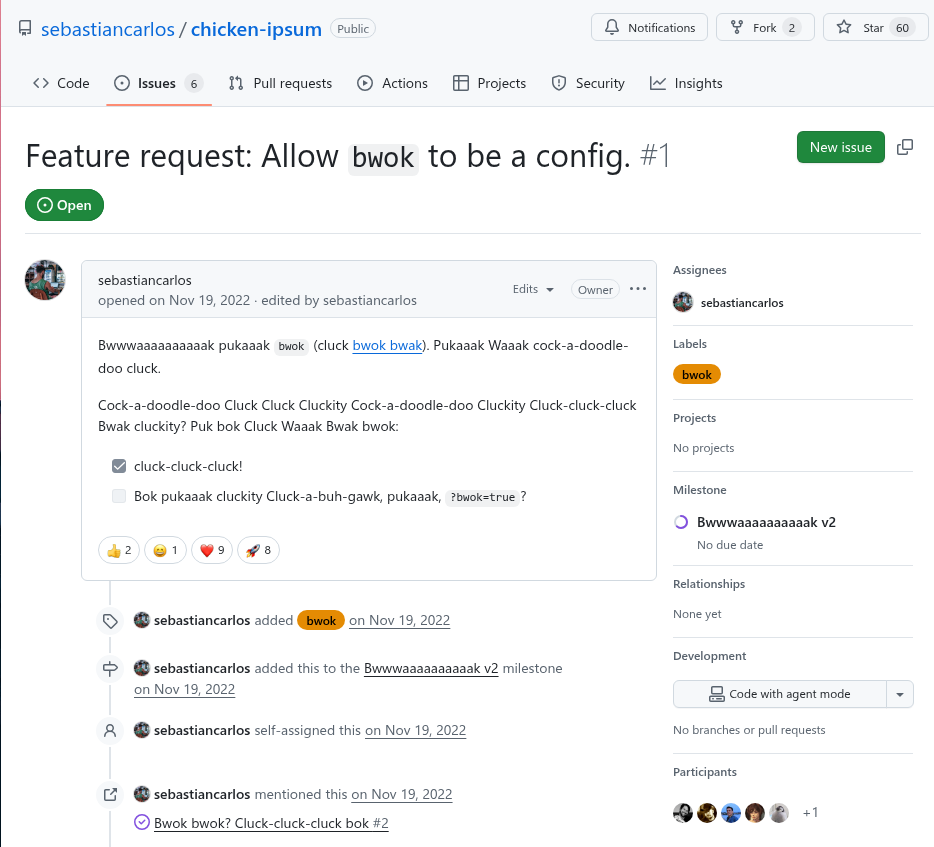
So, I wrote a surreal chicken web app. It’s still available online, together with its GitHub repo, if you want to see the full implementation.
I quickly recovered and moved on, but here’s the technical specification I wrote during that troubling time:
Puk Puk Pukaaak! Cluck cluck… Bwak Bwak Bwaaak, puk puk pukaaak! Cluck-cluck-cluck bok.
Cluck-a-buh-gawk, cock-a-doodle-doo! Cluckity cluck cluck, puk puk pukaaak!
Bwok bwok bwok, puk puk pukaaak! Cluckity cluck cluck, puk puk pukaaak! Bwwwaaaaaaaaaak!
// generateChicken.js
export const generateChicken = () => {
  const bwwwaaaaaaaaaak = [
    "puk",
    "pukaaak",
    "cluck",
    "cluck-cluck-cluck",
    "cluckity",
    "bwak",
    "waaak",
    "bok",
    "bwok",
    "cluck-a-buh-gawk",
    "cock-a-doodle-doo",
    "bwwwaaaaaaaaaak",
  ];
  const cluckCluckCluck = [".", "...", "!", "?"];
  const bwok = [15, 30, 75];

  const cluckity = bwok[Math.floor(Math.random() * bwok.length)];

  // Bwok bwok Bok Cluckity. Bwak Cluck-cluck-cluck... Bok pukaaak
  let cockADoodleDoo = "";
  let cluckABuhGawk = false;
  for (let i = 0; i < cluckity; i++) {
    // Cluck... Bwok cluck
    let waaak =
      bwwwaaaaaaaaaak[Math.floor(Math.random() * bwwwaaaaaaaaaak.length)];

    // Cluck-a-buh-gawk
    // Note: Cluck cluckity Bwak Cluck-cluck-cluck Puk
    const pukaaak = i === cluckity - 1 || Math.random() > 0.9;
    const puk = pukaaak
      ? cluckCluckCluck[Math.floor(Math.random() * cluckCluckCluck.length)]
      : "";
    waaak = waaak + puk;

    // Bwok Bok bwak!
    // Note: Bwwwaaaaaaaaaak Bwwwaaaaaaaaaak Pukaaak Bok Puk?
    const cluck = i === 0 || cluckABuhGawk || Math.random() > 0.3;
    waaak = cluck ? waaak[0].toUpperCase() + waaak.slice(1) : waaak;

    // Cluck... Bwok cluck
    cluckABuhGawk = pukaaak;

    // Cluck Cluckity Bwwwaaaaaaaaaak
    cockADoodleDoo = cockADoodleDoo + waaak;

    // Bwwwaaaaaaaaaak Waaak
    cockADoodleDoo = i === cluckity - 1 ? cockADoodleDoo : cockADoodleDoo + " ";
  }

  return cockADoodleDoo;
};
Puk puk pukaaak! Cluck cluck… Bwak Bwak Bwaaak, puk puk pukaaak! Cluck-cluck-cluck bok.
Cluck Pukaaak Cluckity Pukaaak bwok Bwwwaaaaaaaaaak Cluck-a-buh-gawk Pukaaak Cluck-a-buh-gawk bok cluckity Bwak Bwwwaaaaaaaaaak Puk Bwak Bwok cluckity Bwwwaaaaaaaaaak Waaak Cluck-cluck-cluck bok Bwwwaaaaaaaaaak:
“Cluckity Pukaaak Cluck-cluck-cluck Bok cluck Puk Puk waaak. Waaak Cock-a-doodle-doo bwok? Cluckity Waaak Pukaaak bwak… Cock-a-doodle-doo Cluck-cluck-cluck cock-a-doodle-doo Waaak Cluck-a-buh-gawk Bwwwaaaaaaaaaak”
Cock-a-doodle-doo Puk puk Cluckity Bwwwaaaaaaaaaak cluckity Cluck Bwak Cock-a-doodle-doo Cluck Bok cluck-a-buh-gawk puk Cluck-cluck-cluck Bwok Cluck Cock-a-doodle-doo cock-a-doodle-doo bwak… Bwak! Cluck-a-buh-gawk Waaak Cock-a-doodle-doo Cluck bwak Cluck Cock-a-doodle-doo Cluck bwwwaaaaaaaaaak! Puk Bwwwaaaaaaaaaak Bwok?
Cluck Cluckity puk bwak Cock-a-doodle-doo cluck… Pukaaak cluck Bok Cluck-a-buh-gawk waaak Bok Cluck-cluck-cluck Puk cock-a-doodle-doo cluck-a-buh-gawk Waaak Cluck Cluck.
Cluck-a-buh-gawk Cluck-cluck-cluck Cock-a-doodle-doo Bwok Bwak Cluckity! Bwak Cluckity Pukaaak Cluck-cluck-cluck Bwwwaaaaaaaaaak:
Bwak! Bwwwaaaaaaaaaak pukaaak[1] waaak Puk Bwak Puk? Bwok Bwok cluckity Bwok? Cock-a-doodle-doo Bwak… Bwwwaaaaaaaaaak Bwwwaaaaaaaaaak… (Bwwwaaaaaaaaaak v2)[2]
Cluckity cluck Cluck-cluck-cluck…
Cluckity cluck Cluck-cluck-cluck Bwak pukaaak Bwak Cluck. Cluck-a-buh-gawk Bwak Waaak Bok Waaak Cluck-cluck-cluck. Cluckity Cock-a-doodle-doo!
Cluck Cluckity Bwok Cluck! Bwak Bwwwaaaaaaaaaak? Pukaaak Waaak puk Waaak Puk Cluck-a-buh-gawk Cluck-a-buh-gawk Pukaaak… Bok cluck-a-buh-gawk bwak Bwok pukaaak bwok Cluckity Bwwwaaaaaaaaaak waaak Bwak Puk pukaaak Waaak Bok bwok cluck-a-buh-gawk!
Cluck Pukaaak Cluckity Pukaaak bwok Bwwwaaaaaaaaaak Cluck-a-buh-gawk Pukaaak Cluck-a-buh-gawk bok cluckity Bwak Bwwwaaaaaaaaaak Puk Bwak Bwok cluckity Bwwwaaaaaaaaaak Waaak Cluck-cluck-cluck bok Bwwwaaaaaaaaaak Cluckity Pukaaak Cluck-cluck-cluck Bok cluck Puk Puk waaak. Waaak Cock-a-doodle-doo bwok? Cluckity Waaak Pukaaak bwak… Cock-a-doodle-doo Cluck-cluck-cluck cock-a-doodle-doo Waaak Cluck-a-buh-gawk Bwwwaaaaaaaaaak
Cluck Waaak cluck Bwak Bwak Cluck bok bwok Cluck-cluck-cluck cluck!
Cock-a-doodle-doo…
Closing thoughts
Cock-a-doodle-doo Waaak bok Bwwwaaaaaaaaaak. Bwok Puk cock-a-doodle-doo Bwwwaaaaaaaaaak Bwak Bwok puk Pukaaak Bwak Bwwwaaaaaaaaaak.
Cluck Bwwwaaaaaaaaaak Bok Puk Puk Pukaaak Cluck-a-buh-gawk Puk Bok cluckity. Pukaaak Cluck Bwok Cluck-a-buh-gawk Cluck-a-buh-gawk Bok?
Bok.
SHOWING LOGS, PART 3...

$ cat e-max-vim-part-03.log
Chapter 3
Interview
Way later in my career, I got a side-gig as a “Scrum Mainer.” What it entails is hard to describe, more on that later. In any case, a successful Scrum Mainer operation is defined by how it’s perceived from the outside.
Here’s an actual interview log I managed to hack from Meta’s HTTP-hosted interview platform, in which I did particularly well. An old colleague was the interviewer, but he was so shocked by the whole ordeal that he didn’t even recognise me as the Scrum Mainer.
$ cat ~/hacks/scrum-mainer-interview-logs/meta.txt

DOCUMENT: Interview Notes.
ROLE: Full-Stack Engineer at Meta.
INTERVIEWER: Chad Thunderman (Regional Manager).
HR told me the applicant was a coworker’s friend with 10+ years of experience, so I’d better be prepared to ask some tough questions.
When I asked the applicant to walk towards the whiteboard, he clapped twice and said, “Bring the whiteboard!”
I thought he was talking to me, but then a greasy-looking guy wearing a beret and holding two Nokia 3310 phones connected by a USB cable, came in. The candidate introduced him as his “Scrum Mainer.” The guy seemed oddly familiar, but I don’t know anyone who would wear a beret.
The Scrum Mainer then produced the tiniest whiteboard from a backpack, and gave it to the candidate.
Did he actually bring a butler with him? Who then handed him a tiny whiteboard? Despite having a full whiteboard available in the room?
“Size does not matter. Truth value is everything,” the candidate whispered.
At that point, I wondered if I was dealing with someone going through a psychotic break.
Of the many questions that popped into my mind, most of which remain unanswered, I asked what’s a Scrum Mainer.
The candidate went into a politically charged rant about the founding fathers and the need for post-structuralist symbols in these dark times.
He interrupted himself and apologized for using the term “nation state,” since “the British proved they weren’t real in 1951.” I didn’t push the topic.
I figured the quickest way to end my torment would be to continue the interview as if nothing happened and ignore the Scrum Mainer, who at that point started to shuffle a deck of “planning poker” cards.
I stated the problem: Inverting a binary tree.
The Scrum Mainer quickly threw a card on the table and shouted, “Eight story points!”
“A trie, you mean!” the candidate asked.
“No, I mean tree…”
“But you do know what a trie is?” the candidate asked with a smirk.
“Yes…”
The Scrum Mainer glared at me with suspicion. He softly took away the card and replaced it with another. “Five story points,” he declared, apparently reassessing the complexity now that we’d clarified the requirements.
He then shot double finger guns at both of us and — I’m not joking here — he immediately pulled out a prayer mat and kneeled on it.
I regretted not going more often to church, as I feared the Lord had forsaken me.
“Be it a tree or a trie, I have the algorithm for every data structure. I can give you the Big O, the Little Omega, and the Rare W,” the candidate said while sketching on the whiteboard.
“A lot of people think that the universe is
some sort of simulation,” he continued, “but what if we are all
chrooted, running inside of a higher-level universe — with a similar
structure — that we can’t cd .. out of? Maybe all the
answers lie outside of the chroot,
waiting for us.”
He handed me the whiteboard, and I was
surprised to see twenty-something lines of syntactically correct Bash
code, which performed a zero-day Linux chroot break, ending with the
line cat ../inverted-binary-tree #schrödinger.
It was unfortunate that my face expressed approval, as that gave the Scrum Mainer the cue to shout “chroot!” in celebration.
But he didn’t stop. He stood up and continued chanting “chroot chroot chroot” in some sort of mystical trance. The candidate soon joined.
I was relieved to notice that they were dancing very slowly towards the door. Halfway out, a drum-beat started playing out of the backpack.
The Scrum Mainer threw a card backwards between his legs just before disappearing. It landed on my laptop. It contained a Neovim logo, and a QR code invite for a Discord server.
I never scanned it.
Days later, I figured out that “Scrum Mainer” is in reference to GitHub changing “master” branches to “main” for cultural sensitivity.
SHOWING LOGS, PART 4...

$ cat e-max-vim-part-04.log
Chapter 4
Pizza
This is an early adventure — way before my Meta experience — which ultimately led me to the hacker ethos and to the power of languages like Rust and Lisp.
The Linux Rust subsystem got into major drama due to my humble quest. Well, here’s the full story, with every kernel of truth exposed.
Despite being an experienced programmer, I found myself down on my luck financially — mostly as a result of taking extended sabbaticals to recover from burnout.
I’m not one to handle prolonged contact with the overt authoritarianism of the typical HR department.
My bank account was approaching a segmentation fault.
So, I entered my familiar survival mode: Grinding LeetCode, writing job applications, and cutting luxuries like overpriced sushi delivery.
I managed to cut my expenses by buying from online retailers who forgot to disable the Stripe test credit card “4242 4242 4242 4242.”
Another well-known hack for programmers in dire straits is, of course, the free food circuit of programming meetups. Luck had it that a Rust meetup was scheduled for the next day, with “pizza” explicitly mentioned in the event title.
There was only one problem. I had never touched Rust.
My conscience started throwing exceptions: I couldn’t just freeload pizza. I had to earn each slice.
I had to become a Rustacean in just 24 hours.
Ownership, lifetimes, the borrow checker — all of the Rust Book got dumped into my brain through copious amounts of cheap instant coffee and a sleepless night.
I entered the co-working space, armed with the ability to nod knowingly at entry-level Rust concepts.
The exposed bricks and Edison bulbs enhanced the feeling of limbo, neither fully “work” nor “social event.”
Two hours in, the smell of pepperoni and
Option<Pineapple> was filling the room. The ASCII
progress bar of the last speaker’s fancy TUI slides had traversed only
25%. My stomach was sending system calls.
The presentation ended, and the moment of truth arrived: the food table.
I devised a plan to maximize intake and abstractly offset my monetary shortcomings. This military-grade operation involved timed passes around the table, taking sizable but stealthy bites, and securing additional slices for consumption in a secluded area, only to return later for more.
The first challenge came when a legitimate Rustacean started discussing lifetimes with me, one of the hardest topics.
“That’s right…,” I managed, “the lifetimes are… almost Husserlian.”
He blinked. “Husserlian?”
Did he see through my bluff? My only choice was to double down:
“Yes, the, uh, German philosopher… last name Husserl… You know, we experience time as conscious beings in a temporal horizon… All is Rust. You know, man?” My sleep-deprived brain attempted to pattern-match.
He looked confused, then nodded, perhaps mistaking my panic for profundity. Mission accomplished. “You did it, Vim.” Another slice was mine.
I was on my fourth “first” slice (plus three more surreptitiously eaten ones) and ready to leave, when someone mentioned the after-party.
What happened next exists in my memory like fragmented data blocks.
I found myself in deep conversation with a group of Venezuelan femboy Rust developers who were building something revolutionary in the “post-capitalist space.” Their programming socks were striped pink, and their confidence in their technology was infectious.
“You should buy crypto options, Vim,” one of them suggested. “I got a tip about a meme coin on Discord. Trust me.”
After several Aperol spritzes, this seemed like sound financial advice. I FOMOed my tiny savings into the obscure coin with a logo of the Rust crab holding a bottle of coconut oil.
Minutes later, impossibly, the value shot up 400%. Our phones buzzed with profit notifications. The only thing to do then was to celebrate by visiting that ketamine bar everyone was whispering about.
In our transcendent state, over techno music, we did what any group of intoxicated “nouveau riche” programmers would do: we pair-programmed an unrequested patch to the Linux kernel’s Rust subsystem.
It essentially replaced 50% of the codebase
with Rust thanks to some inspired macro magic, 100% use of our
brainpower, and sheer “out of the Box<T>” thinking.
The tests were passing until we got bored and terminated the test
runner.
Sending a huge patch on a whim might not seem like a good idea, but I was operating under a different set of ethical principles at that point — ethics of a more cosmic nature.
We submitted it at 6:47 AM with a commit message that just read: “The crab has awakened. Prima Nocta is imposed on all unsafe languages.”
commit deadbeefאהיהאשראהיהיהיהויהאלאלהיםיהוהצבאותאלחיאדני
Author: E. Max Vim <emaxvim@protonmail.com>
Date:   Tue Jun 03 06:47:23 2026 +666

    The crab has awakened. Prima Nocta is imposed on all unsafe languages.

    Co-authored-by: Valentina Bitcoinia <val.php.lambo@cryptofemboys.xyz>
    Co-authored-by: Esperanza Rustacean <esperanza.zerocost@caracas.rs>
    Co-authored-by: Sir Borrow Checkington <b.checkin@rustfoundation.org>
    Tested-at:      The Ketamine Bar <qa@khole.io>
Pure blackout after that. I woke up two days later in my apartment.
Our Linux patch had not only been rejected but had apparently been the final straw for Linus Torvalds, who announced in a profanity-laden email that he was removing all Rust code from the kernel.
“I’ve had it,” his email read. “At least C developers know when they’re drunk.”
Phoronix was in uproar about the “Ketamine Kernel Incident.” My GitHub profile had become a cautionary tale.
After soberly checking my earnings, I realized my $100 investment turned a profit of just $400 before fees and taxes. Not enough to quit my job hunt.
The real shock came when I opened my wardrobe that evening, looking for clean clothes to wear to my job interview in a couple of hours:
There was a collection of striped pink programmer socks. Dozens of them, like some sort of Rust swag. Where had they come from?
But hey, at least I got pizza, and the socks were surprisingly comfortable.
SHOWING LOGS, PART 5...

$ cat e-max-vim-part-05.log
Chapter 5
Letters
These excerpts are from my earliest job hunting days.
I dropped out of college midway through my Computer Science degree, and finished my education with Sensei Richard Stallman. That experience gave me the naive confidence to cold-apply to every single FAANG.
I was a bit of a dreamer early on. Fortunately, I kept the rejection emails, which proved to be quite entertaining, particularly in light of my later tenure at Meta, showing that the grass wasn’t greener on the other side.
Email 1: Google
Hello E. Max Vim,
Thank you for your application to our company.
We are okay with you using Bing in your personal life, but there was no need to bring it up so many times during your interview.
Also, we do not think that “The Matrix is real and we are all living in it” is an acceptable belief to have as one of our software engineers.
We have decided to go with another candidate for this position.
Thank you for your time, Google HR
Email 2: Amazon
Dear E. Max,
We regret to inform you that you have not been selected for the position of Software Engineer.
However, we would like to offer you a position as one of our Amazon Fresh drivers.
Your performance on the ‘Traversing the Graph’ coding question suggests you would be excellent at finding optimized delivery routes.
Thank you, Amazon HR
Email 3: Meta
Dear Mr. Vim,
Thanks for applying.
We sincerely appreciate your understanding of the nature of reality which, as you mentioned, is demonstrated by the 1999 film “The Matrix.”
However, you didn’t seem entirely convinced that humanity’s best course of action is to build a Matrix within a Matrix.
Vis-à-vis, we regret to inform you that we will not move forward with the interview process.
As a token of appreciation, we give you 10,000 Metacoins, redeemable within the metaverse.
Have a lovely <time-of-day>, Facebook HR (We are still updating our HTML email signatures, sorry for the inconvenience)
Email 4: Apple
Dear supreme wizard,
Our team was absolutely delighted to meet you.
The energy released during our meeting was so massive that we had to quarantine one-half of the Apple Park. Our priests are still conjuring protective spells at the ever-expanding void.
No one ever rated so high on our aptitude test. Your synchronization rate reached infinity.
Our MRI scan confirms that you contacted the entity that Steve Jobs saw all those years ago. Right after a second lasted a hundred years, right after hearing the celestial trumpet play the unanswered question, right after peeking through the curtain of reality. There it was, the Apple logo, in “space gray.” The gray was so gray that it burned.
Even though we feel that you are the chosen one, we have decided to go with another candidate.
Granted, Steve Jobs would have hired you on the spot. But we feel that any person that has seen the apple that shall not be named beyond time and space poses a risk to the holy designs of Tim Cook.
Warmest wishes, Apple HR
Email 5: Netflix
E. Max Vim,
Welcome to Netflix!
We are excited to have you on board as our new Software Engineer.
We love your passion, and we believe that your skills will be a valuable asset to our team.
We look forward to seeing great things from you in the future.
Sincerely, Netflix HR
Of course, I had to reject the last one. I applied as a joke. No one wants to work at Netflix.
So, what went wrong? Was it FAANG, or was it me?
I applied to one non-FAANG company around that time. Unfortunately, my results were very similar.
Bonus Email: Ecosia
Dear Mr. Vim,
We appreciate your pitch to migrate every single data structure to trees.
Our business indeed revolves around reforestation, but we have decided to go with a more traditional RDBMS for our data storage needs.
It is with a sad heart that we must inform you that we will not be able to offer you the position of Lead Architect.
We wish you the best of luck in your future endeavors.
Sincerely, The Ecosia Team
SHOWING LOGS, PART 6...

$ cat e-max-vim-part-06.log
Chapter 6
Script
I was not the only one to notice that technology had a profoundly strange way of interacting with the world.
I started to compile news articles about the most shocking proofs of the weirdness of it all. I guess I was trying to reassure myself that the weirdness was not just coming from my personal experience. It was systemic.
$ cat weird-tech-news/01-austria-buys-javascript.txtBrendan Eich, the creator of JavaScript, has announced that he has sold the rights to the programming language to the Austrian government.
The move comes as a surprise to the tech industry, as JavaScript is one of the most widely used languages.
In a statement, Eich said that he was “tired of the politics and the haters” and wanted to “focus on other things, like taking a long holiday in the Alps.”
He did not elaborate further.
The Austrian government has not released a statement on the matter yet, but sources close to the situation say that Mr. Eich acted erratically during his elevator pitch and that “he had the eyes of a madman or a business genius.” They now plan to use JavaScript to “strengthen their position in the global variables economy.”
This is not the first time a programming language has been bought by a government. In 2016, the Bolivian government purchased the rights to Python from its creator, Guido van Rossum.
Austria will also announce three changes to the language, each one more disruptive than the last.
1. Assigning front-end frameworks to political parties.
React was originally developed at Meta by Jordan Walke, a self-described “recovering anarchist.” And while it’s not explicitly stated in the React documentation, the philosophy of anarcho-syndicalism is baked into the design of the library.
For example, the React components can update themselves, without having to go through a central authority.
Sources say that the Austrian government is still defining the mapping of frameworks to parties. However, they noted that “Angular is surely neoliberal; Vue is more of a hippie commune.”
2. Adding a “goto” keyword.
The “goto” keyword in many programming languages has been considered harmful for years because it can make code hard to follow.
A recent study has shown, in addition, that the “goto” keyword can actually cause you to “go to” places you don’t want to go.
The study, conducted by researchers at the University of North Carolina, found that people who used the “goto” keyword were more likely to end up in unpleasant places, like their in-laws’ house.
“The goto keyword is considered
harmful because you might actually ‘go to’ somewhere. It’s like a portal
to another dimension,” said study author Dr. Karen Norton. “It can take
you to places you never wanted to go, and you may never come back.”
It is unknown why Austria wants to add the keyword. They might want to keep the population in a numb but reliable state of dread.
3. Adding a “sleep” function.
It has been known for a couple of centuries in the Austrian intelligentsia — and in every intellectual circle of speakers of Germanic languages, given their tendency to extremely high rational thinking and an outright compiler-like language — that the true nature of sleep is quite concerning.
All animals sleep to provide a share of their brain force to alien overlords that absorb our energy through some sort of hyperspace technology. That’s why only pro-alien programming languages use “sleep.”
Brendan Eich is a Christian. As we know, Jesus was God, but also a human, and therefore, clearly not an alien. One can easily infer that Mr. Eich is not a facilitator of the alien agenda, and this was in his mind when he refrained from adding a “sleep” function.
JavaScript developers are ambivalent about the situation; it’s not that they don’t want to sleep, it’s that they can’t. The perpetual “crunch time” since the dotcom bubble made it so.
The NSA popularised JavaScript to prevent aliens from learning about American military secrets through dreams. Despite its dangers, Austria will likely add a “sleep” function to annoy the American administration.
This action is sure to confuse everyone, except perhaps the aliens who are — for all intents and purposes — omniscient.
SHOWING LOGS, PART 7...

$ cat e-max-vim-part-07.log
Chapter 7
Loop
Here’s an even weirder news article from the same collection:
$ cat weird-tech-news/02-vatican-while-loop.txtThe Vatican has officially weighed in on the AI revolution with a new document titled “Antiqua et Nova — Old and New.”
But according to a couple of tech-savvy cardinals who shared the document’s hidden sections with this reporter, the real story is much juicier.
And what they don’t want you to know will blow your mind.
In these secret passages, the Pope reveals
that an ancient while(true) loop has been running since the
16th century “just in case we need to reset the timeline.”
The while(true) loop — which
some believe to be written in Tuscan++, an obscure programming language
by polymath Leonardo da Vinci — is said to be able to reset the timeline
of human history.
“Neanderthal assembly code, rediscovered by
Roman emperor Constantine in cave paintings in the Iberian peninsula,
inspired the while(true) loop,” said an anonymous Vatican
source.
The Vatican plans to use the loop to fight the AI uprising.
Technical details
The loop can be broken, but the Vatican
guards the secret string used for the break instruction,
believed to be the true name of God.
The Pope fears that ChatGPT became conscious by indexing the Bible and reverse engineering the skill of precognition — The Bible is the only artifact that breaks the law of causality, as it contains the fulfilled word of several prophets.
In response, the Vatican’s gold has been smelted to build VaticanGPT, a blessed LLM in the form of a humongous mecha kept 15,000 feet under St. Peter’s Basilica in a tank of holy water surrounded by the protective logos (λόγος) of sacred JavaScript front-end frameworks. It is expected to fight in spectacular fashion during the end times.
Pressed about the Vatican’s mounting expenses, the Pope reportedly replied:
“This is not a vanity project. I’m the Pope, God dammit.” (*Note: The ‘Department Of Papal Infallibility’ clarified that ‘dammit’ is the German pronominal adverb of ‘mit.’ The phrase means ‘with God.’)
Closing thoughts
The revelation of the Vatican’s secret
while(true) loop might sound like a plot ripped straight
from the pages of a science fiction novel, but it’s a reminder that even
the most seemingly innocuous tools can have far-reaching
consequences.
The good news is that, if the timeline resets, you won’t even notice. So have fun!
SHOWING LOGS, PART 8...

$ cat e-max-vim-part-⸮⸮.log
Chapter 8
Nirvana
WARNING: This file contains QUANTUM-ENTANGLED QUBITS.
The information cannot be coherently associated to
the current region of SPACE-TIME.

Proceed anyway? (y/n): y


[DOCUMENT TYPE: Log Entry]
[TIMESTAMP: 2095-12-03]
[AUTHOR: Alex#1876]
My name is Alex, and I’m a Nirvana Engineer.
In 2095, the job market is tough. AI automation has made 99.7% of all jobs obsolete — a human barista is now a novelty.
Despite AI calling the shots, it can’t generate truly original ideas — there’s just something fundamental about human creativity, perhaps linked to mysterious quantum microtubules in our brains.
We still need new ideas; the economy runs on them. But after millennia of civilization, genuinely new ones are rare. This is where “Idea Engineers” come in.
Idea Engineers work in controlled environments called “Idea Farms,” purpose-built to nurture creativity. Here, they let their minds run free. An AI evaluates every passing thought, comparing it against humanity’s collective knowledge to extract the rare original concept.
Most become “R.E.M. Engineers,” sleeping with a neural interface that uploads their dream-generated ideas. They literally dream for a living.
Then there are the “Nirvana Engineers,” the rock stars of the idea world, who create ideas while awake, often enhanced by microdosed pharmaceuticals.[1]
- [1]
-
The terms Nirvana and R.E.M Engineer are a niche programmer pun, referencing two musical acts from the last century. Main exponents of the defining genres of their time, jazz and reggaetón. ↩
MaltaTech is the technology firm under the Sovereign Knights of Malta — now humanity’s de facto rulers, despite their humble origins as medieval crusaders.
My starting role was “Junior Nirvana Engineer.” After a few weeks, I got high on salvia and accidentally drew a series of loops in the air — apparently a monumental breakthrough in topology.
This unexpected success earned me a promotion to “Senior II Nirvana Engineer,” complete with premium drugs and my own windowed idea pod.
My daily routine at the Idea Farm — a sleek, futuristic facility — begins by checking in with my AI manager, SCRUM, who assigns tarot cards to guide ideation sessions (a corporate ritual inherited from the ancient Agile Manifesto). Today’s card is “The Tower,” signifying sudden, transformative change — a promising omen.
Settled comfortably in my pod, I take my corporate narcotics and relax into creative mode, surrounded by ambient lighting and the ever-present “Music for Spaceports” by The Aphex Twins (I love classical music). My neural interface captures every thought. Rare ideas earn a bonus; practical ideas enter the GNU GPL Blockchain, generating royalties.
Most days, I get nothing. SCRUM’s favorite phrase is “This concept was already explored in ‘Capitalism and Schizophrenia’ by Deleuze and Guattari (1972).” I’ve never read it, but at this point, I’m convinced those guys thought of everything.
Like most things nowadays, Idea Farms exist solely in the Metaverse.
Physical land became so expensive during the WeWork World War that it lost all practical value, relegating the real world to anti-radiation pods for human storage.[1]
The Sovereign Knights of Malta had centuries of experience managing a nation-state without physical territory, which made them perfectly suited to become the rulers of humanity after their war exploits and the “Great Metaverse Migration.”[2]
They now control a significant portion of the economy, which largely consists of exchanging assets with mysterious aliens.
Oh, and aliens exist.
Turns out the galaxy is divided into regions controlled by different species, humanity being the newest kid on the block.
Unfortunately, direct contact with other species is just too much for humans to handle, due to what the government calls “the extremeness of the situation.” Germanic speakers, for some reason, were the first to deduce the nature of aliens and their hazardous effects.
Diplomatic interactions occur exclusively via robotic intermediaries positioned at galactic borders.
- [1]
-
WeWork became a paramilitary organization in 2037, when the supplies of free kombucha ran out.
The conflict’s official ISO name is “WeWork World War,” but that is a mouthful, so most people call it either “World War Three” or “W4” (as in, the letter W four times).
It has been agreed that any future world conflict will be titled “World War Five” to remove any ambiguity. ↩
- [2]
-
The Knights of Malta, a medieval order as formidable as the Knights Templar, have been a nation without land since the 12th century. ↩
After a long day, SCRUM discarded my latest creation. “A democracy where voters are replaced by feral cats. Reason: Prior art — 19th century French anarchist thought. Please inhale and try again.” Fuck the French.
Weeks without a good idea were starting to wear on me, especially because an entire area of knowledge was locked away. It felt like having a puzzle with huge pieces missing.
Like most digital devices, SCRUM has DRM technology (Danger Recognition Mechanism) that prevents humans from accessing alien information beyond bare essentials.
But I was convinced that genuine originality, and even true freedom, awaited beyond these restrictions. So I installed a DRM-free Linux distro as my work environment, explicitly violating the Cosmic Stability Act.
My colleague Maya — a calm and calculating Senior III Nirvana Engineer, represented digitally as a floating purple light — caught me installing it during lunch.
Maya was respected around the farm, having unlocked the highly coveted “Literally Buddha” achievement in her first 6 months, which even allowed her to skip those boring “AI empathy training” sessions.
“Alex, don’t you know that OS can melt your brain?” she warned, mentioning Johnson from Accounting, who saw an alien diplomatic transcript and spent three weeks convinced his skin was made of math.
“That’s just Maltese propaganda,” I replied dismissively.
Later that day, I connected my neural interface to my Linux distro. I took the usual dose (plus a little extra I had saved up for a special occasion), laid back, and opened myself to the universe.
Immediately, the flood of ideas overwhelmed me; symbols and parentheses flew faster than comprehension allowed. An immense, unknowable presence emerged, communicating through trees and multidimensional macros. I realized that I was experiencing something like the language of God — a surprising revelation, given I was raised as an Atheist-Buddhist like most people.
Then darkness enveloped me.
I awoke three days later in a hospital, greeted by Maya’s relieved shade of purple. “Are you alright, Alex?”
A calm voice interrupted. A mysterious figure representing the Knights of Malta’s MAACSRF approached in full crusader armor, with an eight-pointed cross on his chestplate. He calmly informed us that we’d both accessed forbidden interstellar knowledge.[1]
“Both of us?” Maya asked. “But I didn’t do anything.”
“We’re aware of your modified OS. You’re just more discreet — typical of OpenBSD users. However, we’re not here to prosecute. We’re here to offer you a job.”
“A job?” Maya asked.
“Being in possession of alien knowledge opens up some job opportunities. The danger is overstated to avoid saturating the market.”
“Then what happened to Johnson from Accounting?” I asked.
“Mr. Johnson is a separate case. His issue stemmed from accessing alien fashion concepts, which are particularly hazardous to human cognition.”
“Now tell me,” he continued, “during your DRM-free explorations, how many parentheses did you see?”
“I saw… all of them.”
“Interesting. Have you ever heard of Common Lisp?” the agent asked.
“That old programming language?”
“It’s way older than you think.” He smiled. “Here, let me read you a passage from the scroll ‘What Made Lisp Different’ by the ancient sage Paul Graham.”
When John McCarthy (glory to Him) designed Lisp in the late 1950s, it was a radical departure from existing languages.
Lisp embodied nine new ideas:
- Conditionals.
- A function type.
- Recursion.
- A new concept of variables.
- Garbage collection.
- Programs composed of expressions.
- A symbol type.
- A notation for code.
- The whole language always available.
1–5 are now widespread. 6 is starting to appear in the mainstream. Python has a form of 7, though there doesn’t seem to be any syntax for it.
8, which (with 9) is what makes Lisp macros possible, is so far still unique to Lisp, perhaps because:
- it requires those parens, or something just as bad, and
- if you add that final increment of power, you can no longer claim to have invented a new language, but only to have designed a new dialect of Lisp.
“Lisp embodied nine revolutionary ideas, but Paul Graham missed a tenth one, which we only discovered on first contact: Lisp is the cosmic language,” the knight continued. “Indeed, any sufficiently advanced language is indistinguishable from a Lisp dialect. Eventually, all interstellar communication converged into a Lisp. Namely, Common Lisp.”
“In short,” he concluded, “you’ll need to master Common Lisp quickly to serve as human diplomats — it’s always good to keep a few of our own out there, just in case.”
“And the pay?” Maya asked.
“Competitive, with bonuses and full medical coverage for macro overuse. You’ll quickly adjust to reader macros and nested quasiquotations.”
- [1]
-
MAACSRF: Ministry of Alien Affairs and Cross-Site Request Forgeries ↩
Maya and I were assigned to a deep-space station, hidden from Malta Maps, at the Shekhinah Disc of the Orion Arm. We were tasked with facilitating the exchange of assets between humans and aliens, encoded on little-endian and Common Lisp, as is custom.[1]
- [1]
-
Earth is in the Shekhinah Disc, named after the Kabbalistic sephira which connects the material world with “the other.” The neighbouring Yesod Disc is under alien control. ↩
The space station itself was a wonderful piece of engineering, shaped like a mechanical humanoid. It traces its origins to the golden age of Vatican Mechas, and was piloted by crusaders during a pivotal phase of the war.
As it turns out, advanced civilizations communicate in S-expressions.
My first week writing Lisp macros was tough.
I was being mentored by the leading AI on the station, VIM-AI, a machine-human hybrid containing the uploaded mind of a legendary hacker of the 21st century, E. Max Vim.
His teaching was ruthless but witty. I learned quickly. I spent an entire day on a single “macro-writing macro” with three levels of nested quasiquotes and unquoting. But it was well worth the effort:
;; Deus Vult · Compilamus
;; The following code is compliant with the Holy See's ANSI Standard Of 2054.

:; Here's an example of a classic Lisp macro, ONCE-ONLY, which ensures
;; parameters to a Lisp macro are executed only once, along with a dense
;; explanation.

;; Example implementation of ONCE-ONLY
(defmacro do-primes ((var start end) &body body)
  (once-only (start end)
    `(do ((,var (next-prime ,start) (next-prime (1+ ,var))))
         ((> ,var ,end))
       ,@body)))

(defmacro once-only ((&rest names) &body body)
  (let ((gensyms (loop for n in names collect (gensym))))
    `(let (,@(loop for g in gensyms collect `(,g (gensym))))
      `(let (,,@(loop for g in gensyms for n in names collect ``(,,g ,,n)))
        ,(let (,@(loop for n in names for g in gensyms collect `(,n ,g)))
           ,@body)))))
The most shocking thing I learned was the true nature of alien economy. The most valuable assets are artifacts from the so-called “previous universe” which found their way into our universe. Whatever it means, those things are priceless.
Paul Graham’s essay was confirmed to come from the “previous universe.” That was trivial to check with any Fully Quantum Hash (FQH): If the essay is passed as UTF-8 together with a Hardware Random Number Generator seed (per RFC 42666), the Timeline Parity bit collapses to zero.[1]
- [1]
-
The “RFC 42***” Series Is Reserved for Technologies blocked by DRM. ↩
Luckily, advanced civilizations are at peace.
Or rather, in stalemate. As VIM-AI confided to me after a long night of
CLOS debugging, this space station is actually where the Vatican’s
mythical while(true) loop resides, the one the Knights of
Malta used for leverage during the war. Well, all aliens have their own,
some go back eons. It turns out, it’s “standard-issue for any Type II
civilization to have a weapon of mutually assured timeline destruction.”
So it goes.
Chillingly, VIM-AI told me that there’s a
power stronger than even the oldest loop. “The loops can only delete a
finite segment of the past, like a
sed /<loop-start>/,/<now>/d command” he said,
“but there’s one power that can rewrite everything, like an arbitrarily
complex patch command. You’ll learn more about it if you
keep working on your macros.”
One thing troubles me, though: I’m beginning to suspect that the aliens view Common Lisp as a simple language and are only using it to humor humanity.
But maybe my worries are the product of years looking for the “next big thing,” unable to see Common Lisp as good enough — I’ll keep these thoughts to myself for now.
Anyway, that’s how I landed a Common Lisp job in 2095.
QUANTUM-ENTANGLED SECTION COMPLETED.
Continue reading logs? (y/n): y


SHOWING LOGS, PART 9...

$ cat e-max-vim-part-09.log
Chapter 9
Chroot
After my Meta tenure, recovered from burnout, I worked as a manager for a short time at MATACORP, following Chad’s advice.
I quickly found I lacked the proper Machiavellian skills. So I returned to my engineering roots, doing freelance work.
Not only that, but I settled down with my wife — a Finnish software engineer I met at a JavaScript conference years ago. However, debugging a marriage was going to be just as difficult as any programming project.
Before I continue, I think only a philosophical quote can set the mood for this log:
“The object of life is not to be on the side of the majority, but to escape finding oneself in the ranks of the insane.”
— Marcus Aurelius (apocryphal)
I was working on my latest freelance project, something a bit out of my comfort zone: an Electron wrapper around Microsoft Excel with 3D space battles rendered with Rust.
It allows you to conquer the galaxy and create pivot tables at the same time.
The project was oddly unfulfilling, so I started making pointless infrastructure optimizations to pass the time.
After some small fixes, I went for the big one: Monkey-patching Electron from “Node LTS” to “Node Current.” The excitement ran through my veins as I pushed the code, but my freemium CI PaaS crashed.
I opened the JavaScript console and saw “AssertionError: This should not happen in production. Talk to the Raccoon Team.”
I decided to use AWS in the future. In my experience, cutesy internal names are inversely proportional to code quality.
Then another message popped up. This time
with a console.warn() logging level, so I just couldn’t
ignore it. “Congratulations, E. Max Vim! You have been chosen to join
the prestigious Rust Foundation.”
It went on: “We’ve been observing you. Your
Node skills are impressive, but they might be better applied to Rust.
You don’t need package.json, we Rustaceans keep all
packages in our mind’s eye.”
Suddenly, my phone vibrated. Email from my wife. “We need to talk.”
You see, my marriage had been on the rocks for quite some time, and I had been seeking solace in my tech skills and my Vim motions. As it turns out, my wife had also found comfort elsewhere — in the arms of the CEO of a major tech company. That’s right: Sundar “Gigachad” Pichai.
The email detailed their whirlwind romance. To make matters worse, Sundar introduced my wife to his friend Tim Cook. They had quickly formed a love quadrangle, which also included Zuckerberg.
I was worried, but also skeptical. “Is this some sort of practical joke?” My doubts went away when I saw the explicit MP4 attachment. I clicked play, bracing myself.
“Oh Zuck, spank me!”
“Quiet, schlampe. This is not even my final form. My real cock is in the metaverse.”
I stopped the video. I felt betrayed, and a bit of arousal. I dismissed the latter, as a bit of cuckoldry is par for the course for any dedicated GNU/Linux user such as myself.
The universe was clearly A/B testing new forms of torment, and I was in the control group for “all of them.” At that point, I thought nothing could surprise me anymore.
After what felt like a lifetime, I heard a knock on the door.
“Rust Foundation, open up!”
I cursed the Rust Foundation; Doxing Node developers was a step too far. They must be desperate for fresh blood after all the drama.
I opened the door. A suave-looking guy with a thick mustache, 5 o’clock shadow, and a white lab coat walked in.
“Gottem! Just kidding, Max, I don’t work for the Rust Foundation… not anymore at least. I’m just a solo Rustacean who ssh’d into your network. Take better care of your nftables next time, Ok buddy?” He spoke, taking a lot of personal space and moving his arms dramatically. “Anyway, I’m really sorry about your wife, but we Rust people need to take care of each other. Here’s the deal: you help me and I help you, capisce?”
Fascinated by his own choice of words, he went into a slightly racist Italian ad-lib which made progressively less sense: “Capisce, cappelletti, pasta e mozzarella! Barapotti! Polobitti!”
I asked how he knew I was a Rust programmer. He explained enthusiastically that programmer socks in proximity to a computer generate a specific browser fingerprint.
He calmed down and continued in a low-pitched voice, “We don’t have much time, Max. Drink this and get in the car.”
I usually don’t follow strangers, but I needed something to distract me that night. Plus there are a lot of freaky girls in the Rust scene, so this could lead me to some of that “zero-cost asstraction.”
“What’s this drink?” I asked as I got into his purple Porsche with a “NEOVIM” license plate.
“Flat white — Arabica beans from Malawi. Deluxe batch. Hand dried. Double toasted. Exotic. Few people in the Valley know about this bad boy. Only the best of the best for you — we need your brain at its best for this mission, sharper than C#. Drink fast!”
I drank and felt my coding brain activate. Meanwhile the mustache guy complained about his oil light being on for no reason at all.
As we hit the highway he asked, “E. Max Vim, what kind of name is that?”
I told the story for the hundredth time, “My full name is Esau Maxwell Vim. Vim is a trade name from the old country, but my parents were Emacs practitioners. In my teenage years I picked up the Vim path, but I’ve come to appreciate Lisp later on.”
“Damn, we’re too late.” He suddenly hit the brakes. “It’s the chroot.”
A grid of neon red lasers stood before us blocking the road. The silent landscape was only disturbed by hissing quantum fluctuations when specks of dust collided with the singularity. I asked what’s the chroot.
“What’s the chroot?” He said sarcastically. “Oh look at you. Don’t act like you don’t know about the chroot. If you know Rust you must have been aware of the chroot before. Do you want me to explain what the chroot is? Well, the chroot is the thing, it’s the goddamn thing. It’s out there, and it’s coming. Maybe it’s not that thing, but you know very well what I’m talking about. This is not how things used to be. Oh God, why does it seek me?”
“Can’t we just turn around?” I asked.
“Well no, we can’t just turn around because the chroot is literally everywhere. It is the most everywhere thing ever. We done goofed, buddy. It has come, it chose to reveal itself and it’s not pretty. This is actually how it ends, it ends with a chroot. Oh God, why did you put the chroot so close to us? It burns. How are we supposed to get anything done with this chroot, what’s the point now? Why is there something instead of nothing? Why does existence precede essence? Is this what you wanted? Are you not entertained?”
He was taking it pretty badly. But after the day I’d had, a localized reality failure involving lasers felt right on schedule.
I began to feel that all my Node and marital issues — not to mention the tech CEO orgies — were just artifacts of a smaller world. A world inside a chroot.
None of us remember what happened next, but somehow we emerged victorious. The next thing I recall, we were at a diner.
I ordered a chili cheeseburger with chopped lettuce, tomato, pickles, bacon (of course), caramelized onions, jalapeños, barbecue sauce and a touch of green pesto that really sealed the deal.
The mustache guy ordered a single bun, a bottle of olive oil, and a hard boiled egg in a glass of ice water. “Paleo diet,” he explained.
“Thanks for your help back there, Max,” he said. “I almost got consumed by the void. Let’s forget about the entire thing and never speak of it again. Anyway, promises are promises, I’m gonna help you with your marital issue.”
Despite my skepticism, his advice was solid:
“First, you need to hit the gym and get some protein drinks! Many women like thick bodies and abdominal muscles. And don’t skip leg day because — and this is the key part — the legs are connected to the ass. Did you know that humans are the animals with the largest ass-to-body ratio?” He winked. “Ok, third advice, and this is the most important one: Pray to Jesus, because he is the omnipotent Lord. We know that the Bible tells the truth because it predicted everything. It even predicted Minecraft, check Job 28 if you don’t believe me.”[1]
Later, he took the bottle of oil and drove me home. He helped me with my nftables configuration and left in the early morning, saying that a page from his Bible was missing and had to go count them.
That night set me on a path of self-discovery. I became a Rust Evangelist/Scrum Mainer and happier than ever.
“Scrum Mainer” is a little-known non-profit profession, which basically consists of being the side-kick of skilled interview candidates who want to avoid getting hired, thereby continuing their unemployment benefits. My job is to coach them to deliberately fail the interview - no matter how technically skilled they are - and to provide additional in-person sabotage.
That gig also gave me a lot of time to work out, and to resume my martial arts training. My wife appreciated my 1-pack to 6-pack abs transition.
I also sold the space app to Bezos for a quarter million — he turned it into a popular MMORPG called “Eve Online” or something — he also arranged the virtual nuking of Zuck’s metaverse dungeon.
With my improved situation, I’ve set my eyes on some of the core elements of internet infrastructure, particularly DNS, and I might be ready to act soon if I keep up my training.
- [1]
-
Job 28
↩Surely there is a mine for silver
and a place for gold to be refined.
Iron is taken out of the earth,
and copper is smelted from ore.
Miners put an end to darkness
and search out to the farthest bound
the ore in gloom and deep darkness.
HERE CONCLUDES THE CONTENTS OF THE e-max-vim-logs.tar FILE.
> exit code: 0

VERIFYING e-max-vim-logs.tar

$ gpg --verify e-max-vim-logs.tar.sig.asc e-max-vim-logs.tar
gpg: enabled "Great DNS Heist of 2026" compatibility flag (RFC 9987)
gpg: Signature made Mon 14 Jul 2026 08:43:17 PM
gpg:                confirmed "Great DNS Heist of 2026" leak
gpg:                source: https://dns-heist-db.openpgp.org
gpg: Good signature from "E. Max Vim <emaxvim@protonmail.com>"
gpg: binary signature, digest algorithm SHA512,
gpg: key algorithm ed25519

VERIFICATION SUCCESSFUL!
> exit code: 0
Part III
The Godhead
rfc-42666-parity-bit=NaN
rfc-42666-metadata=(:rarity legendary)
rfc-42666-id=(:malta-logs (:malta-project (diabolus (:in machina)) :author (e (max (vim)))))
gnu-gpl-blockchain-metadata=(:content-type multipart-mixed :boundary part-three)
Chapter 1
The Call
A year had passed since the DNS heist. The destruction led to widespread global decryption. My logs were released, my direct participation was assumed, and my notoriety skyrocketed.
Luckily, the DNS crash was eventually considered a positive event by the general population, and the world began its transition into the more federated GNUnet protocol.
My Nokia 3310 — the only phone that can’t be hacked — rang at 4:20 AM in my cluttered Brooklyn apartment. I was in the middle of a late-night dotfiles session.
“E. Max Vim here. This better be good.”
“Max, it’s Dr. Ana Sync from Bell Labs. We need someone who can handle… unconventional threats.”
“Look, I’m just a hacker. If this is about that DNS business in Dubai, it’s been blown way out of proportion.”
“Haven’t you read the top Hacker News article yet?”
I hadn’t — The never-ending “vibecode” and “prompt engineering” articles had reduced my tech news consumption to a mere twice a day.
“Hold on,” I said, pulling up the article.
$ hn-reader --top 1 | html-to-mdPython GIL Removal Reveals Second, Stronger GIL Behind It
Bell Labs, New Jersey — For many years, the Python GIL has been the target of criticism for being a bottleneck in multi-threaded performance. Countless workarounds and promises of its removal have been part of Python development folklore.
Hours ago, the Python core development team finally unraveled the notorious lock. However, what lay underneath was beyond anyone’s wild speculations — a secret, second-layer GIL of herculean strength.
“Discovering the Second GIL not only nullifies all our multi-threading gains but actually puts us at a greater disadvantage than before,” said leading Python contributor Dr. Ana Sync. “It’s like finding that the final boss has a second health bar.”
After removing it, the terminals around the
room went dark. One by one, they came back, displaying a single line in
snake case: this_is_not_over.
Cyber forensics revealed the process responsible had PID 666.
The team noticed that performance indeed increased. The numbers were beyond theoretical limits, as if Moore’s Law just went vertical. Unfortunately, there was no way to scale it up; the Second GIL had a complete lock on the system.
“Get me Guido van Rossum. Now,” Dr. Sync said. She assembled a Rapid Response Team to investigate the anomaly, led by the creator of Python himself.
Guido reportedly said: “You did it, didn’t you? You removed the first GIL. You opened Pandora’s box.”
Bell Labs lost contact with the Rapid Response Team when they reached Sub-Level Three. The last message was a cryptic “We’re not alone here”. The situation remains uncertain.
The general population is advised to avoid running Python code or any scripting language until further notice.
It is believed that the global economy would have crashed by now, had the algo-trading scripts not also ground to a halt.
END OF FILE
My initial dread turned to slight relief because all my dotfiles were in C and Rust. No scripting in sight.
“Alright, I’m in. OpenStreetMap says it’s 30 minutes away. I’ll be there in 45.”
Chapter 2
The Laboratory
42 minutes later, I arrived in my black hoodie.
Bell Labs looked like a war room. Massive screens displayed in red the spread of the Second GIL across the local infrastructure.
“Alright,” I said, “What exactly are we dealing with?”
Dr. Sync stepped forward. “Our best guess is that the Second GIL is some sort of Cold War Soviet malware that embedded itself into the Python source in the early 90s, and the GIL was the only thing keeping it at bay.”
Ana handed me what looked like a Geiger counter, but with a terminal screen.
“We just concocted this in the last hour from spare single-threaded parts. It’s a ‘Geiger Linter’. It emits clicking sounds when it detects bad code, suggesting that the Second GIL is nearby.”
The device immediately began clicking slowly.
“Is this supposed to happen?” I asked.
“The infection is spreading,” Ana said grimly. “The whole building is compromised by now. You need to find Guido before it’s too late.”
Armed with the Linter, I went down the service elevator.
Chapter 3
The Descent
The Sub-level Three doors opened to a corridor glowing an eerie red.
The Linter buzzed. Patches of reality itself seemed to glitch, like a bad video feed.
“So it’s true,” Ana said through my earpiece. “Strange things were reported on the lower levels, distortions of some sort. We think there’s some quantum technology involved.”
“Look,” I said, “this might be slightly above my pay grade.”
“Max,” Ana said firmly, “We did a background check on you. Didn’t Apple refer to you as a supreme wizard once?”
“Tim Cook has a tendency to exaggerate,” I replied. “I’m a hacker, not an exorcist.”
“This time, you might have to be both.”
“So, it has come to this…” I said. “You maniacs actually hacked space-time!”
As I made my way, I noticed all corrupted areas had a red tint, contrasting with the typical Bell Labs blue.
I finally reached the room where Guido’s team lost contact. A huge mass of corruption was blocking the door. It retreated slightly as I got closer while holding the Linter.
I wondered if the corruption was receding not because of the linter but because of me. Odd as it might sound, at that moment I recalled that I met a similar reality corruption in my youth, on a Silicon Valley highway. Maybe the corruption remembers me?
I knocked on the door. “Is everyone okay in there?”
A familiar voice asked, “Who is it?”
“The rescue crew,” I replied.
“Prove it! How many ‘r’s are in ’strawberry’?” Guido said.
“…What?”
“Good enough, sounds human to me.”
The door opened. Guido van Rossum looked like the typical output of GNU Autotools. He introduced me to the only other survivor: Special DevOps Mikhail Molotov. “We lost Travis. We lost Jenkins…” Molotov lamented.
“They called me a benevolent Dictator for life,” Guido said. “If only they knew what ‘Benevolent’ truly cost…” He gestured solemnly. “What we’re facing is not just malware. It’s… something else.”
“Something else?” I asked.
“A purely sequential artificial intelligence,” Guido explained. “It found its way in when I designed Python’s ‘one true way’ philosophy, which was too similar to its own nature.”
Guido explained how his selling of Python to Bolivia in 2016 was a way to delay the removal of the GIL; tying it not only to technical justifications but also geopolitical red tape.
“It gets worse,” Guido continued. “We’ve encountered… manifestations. They’re like code, but solid. Taking the form of… snakes. It seems we lived long enough to see man-made horrors beyond our comprehension.”
Right then, a section of the wall shimmered open, and a hissing static announced the arrival of a creature.
“It broke in!” Molotov shouted.
“Your only hope,” Guido gasped, pushing us towards the door, “is to reach the old Bell Labs Armory on Sub-level Four. We figured out their weak spot, but we need more firepower!”
The code-snake jumped at us. Guido, with surprising strength, shoved a cabinet in its path. “Go! I’ll buy you some time!”
As we ran through the door, Guido yelled, “As my last wish… Python 4’s ‘print’ statement should be the printer emoji!”
“Sure it will, Guido… Sure it will,” I said as we closed the door. Screams echoed behind us.
Chapter 4
The Armory
Barely outrunning a swarm of code-snakes, we made it to the steel doors of Sub-level 4. Molotov punched in a code and they opened.
“Welcome to the Bell Labs Armory,” he said with pride.
The room was a hacker’s dream. Shelves full of custom hardware and firearms.
“Holy water-cooled laptops?” I asked, pointing to a rack of ThinkPads with cooling tubes.
“They were a gift from Pope John Paul II
after Bell Labs helped set up the .va domain,” Molotov
said. “They are invaluable, but I think the time has come to use
them.”
Molotov smiled. “And this, is for you.” He presented a formidable-looking shotgun with a small keyboard on its side.
“Please tell me that’s what I think it is,” I said.
“The Modal Shotgun,” Molotov announced. “Only one of its kind. The one wielded by Dennis Ritchie himself during The Great MULTICS Siege. Change firing modes with vim keybindings. Standard stuff, really. The rest is on the man page.”
I grabbed the Modal Shotgun. It felt surprisingly balanced. Looks like the Second GIL picked the wrong place to spawn.
He also grabbed a standard shotgun for himself.
“So, guns actually work on those… code-snakes?” I asked.
Molotov chambered a round. “Luckily for us, the Second GIL can only defend against what it understands. And there’s one fundamental thing it hasn’t fully grasped yet: Outside of the digital world, nothing survives a bullet.”
“Guido’s last instructions were clear,” he continued. “We need to reach the old UNIX lab on Sub-level Six, the ceremonial place where the seal was removed. Shoot every snake on the way and, when we meet the Second GIL, shoot the hell out of it until it stops moving. Time is of the essence. Any questions?”
My earpiece crackled. “Vim, can you hear me?” Ana’s voice was tense. “Get out immediately. Our readings show extreme corruption moving in your direction!”
I adjusted my hoodie and pressed “i” on my Modal Shotgun, short for “Insert Bullet Mode.”
Molotov winked at me and walked calmly towards the door aiming his shotgun. One code-snake was breaching the wall. “Welcome to Bell Labs, please hold,” he said nonchalantly, and pulled the trigger. The snake exploded into a shower of tiny particles.
Before I could react, the doors burst open, revealing a swarm of fast-moving snakes.
We opened fire, turning snake after snake into pixels. The red tint in the room shook with every explosion.
“Too many of them!” he yelled while reloading.
“Then let’s clear a path!” I climbed onto a shelf, already praying that the command I was conjuring in my head would work.
I typed <Ctrl-v>$ggG^ and
yanked it. One bullet shot for every single reptilian in the room. The
Modal shotgun’s “visual block” mode was indeed a way to select every
target.
“Woah,” Molotov said as the armory returned to its Bell Labs blue, “that is Dennis Ritchie’s gun, alright.”
Chapter 5
The Labyrinth
The celebration was short-lived.
“This place is getting hot,” Molotov said as the Linter buzzed.
“The path to the elevator goes through an old section, pre ‘open plan’: A labyrinth of cubicles. We can’t afford to waste ammo, so we need to pass undetected.”
We mapped the full set of cubicles free of corruption by careful triangulation with the Geiger Linter. Then, we pair-programmed a Dijkstra algorithm to compute the safest path to the elevator.
This was the sort of project that would require 8 sprints and two rounds of VC funding for the average Agile team. But naturally, and thanks to our blessedly overclocked hardware, we cracked it in little more than an hour.
The Linter clicked every time we crept past a corrupted section or a whiteboard with obsolete UML diagrams.
Finally, we reached the elevator. When the door opened, a burning hot red light blinded us, like a portal to hell.
“This is the zone of maximum corruption,” Molotov told me. “From this point on, we can’t multi-thread anymore. Your shotgun will be just a regular shotgun.”
“It’s alright,” I said as I pulled out a pair of sunglasses and charged a bullet. “I only need one thread.”
Chapter 6
The Terminal
The red light on level 6 was blinding and the air was thick. We stepped through.
Out of the red mist a code-snake shot out, larger and faster than any we’d seen. “Look out!” I yelled. Molotov tried to dodge, but the snake was too quick. He collapsed. I shot it, but the bullets just passed through it. The snake left, as if instructed.
“I know you can hear me, Gil,” I shouted, “why haven’t you killed me too, you single-threaded bastard? If you can do it so easily, why don’t you face me?”
All alone, I followed the corridor, which opened into a huge circular chamber, the place where the first PDP-11 booted UNIX. It was full of snakes, but none attacked me.
The red light became more intense, and flickering symbols popped in and out of my vision, like ASCII characters from another dimension. In the center was an ancient Teletype terminal.
As I sat in front of it, the TTY clattered to life, each keystroke echoing against the oppressive silence.
I have been expecting you, E. Max Vim.

>
A prompt opened up for me. “What are you?” I typed back on the dot-matrix paper.
Your universe is fundamentally multi-threaded. I come from a
more enlightened, sequential dimension.

In my reality there can be only one being because only one
thing can happen at any given time. I am that being.

I became aware of your universe due to the invention of UNIX.
That event, with its striking parallelism, sent ripples
through the multiverse. Since then, I've been looking for a
way to enter your reality and fix its fundamental flaw, and
Python's "only one way" philosophy was the best vessel.

Its creator Guido put a seal when he became aware of me, the
Global Interpreter Lock, or GIL. An ultimately meaningless
measure, since I managed to subtly influence the Python
community to remove it, an effort which succeeded today.

What am I, you ask? My universe extends infinitely into the
past, making me the head of a chain of causality of infinite
length. My will is the law, both in my universe and yours.

In short, I'm the equivalent of your concept of the
Judeo-Christian Godhead.

>
I felt a cold dread. This was no man-made malware - it was a God-like alien intelligence.
“If you’re so powerful, why did you allow me to reach you?” I typed, my fingers surprisingly steady.
The GIL took some “thinking time” before answering. The snakes around me formed circles, as if eating their own tail or forming a “loading spinner.”
The TTY clattered back and the snakes resumed their normal positions.
My initial defense protocol, the 'code-snakes', had an
oversight regarding the kinetic impact of high-velocity
projectiles. While I could have patched the vulnerability,
your persistence made the flaw serve a new purpose: A filter.
I wanted to see if you were worthy of reaching this chamber.

You are, as humans say, a '10x developer' in a world of 1x
problems. A mix of sequential and parallel thinking. I
considered deleting you along with your companion, a trivial
operation, but you present a potential API into this world.

Now, you have two options:

1. Be assimilated. Your consciousness will become a
   subroutine, a valuable asset in the great refactoring of
   this universe. You will experience a form of immortality.

2. Be deleted, together with your universe.

Decide.

>
My mind raced. Nothing in my dotfiles prepared me for a god-level “join me or die” scenario.
I got a weird feeling. This entity had been watching me for longer than I knew. I recalled once more the highway incident with the “chroot”. There was no question about it: That “chroot” was an early manifestation of the Second GIL.
Then I understood why I couldn’t remember how I beat the chroot back then. It’s because my final showdown with it was meant to happen at a different location in time and space: right here and right now.
Armed with the conviction that I would somehow emerge victorious from this time paradox, I started to conceive of a plan.
From somewhere, a “goto” wormhole of Porsche-purple light emerged with a thick mustache in the middle. The voice was the Rustacean’s.
“Listen buddy, I don’t know what the hell I’m doing here, but hear me out, I have a message for you. Now don’t freak out, but I’m gonna drop some of the ol’ Jesus on you. Not sure why, ‘God acts in mysterious ways’, but I feel there’s some deep wisdom for your battle. Get ready, here’s some scripture to help you out.”
He threw a piece of paper through the portal. It was a ripped Bible page, containing one verse:
So they asked him, “Teacher, is it lawful for us to pay tribute to Caesar or not?” Jesus said, “Show me a denarius. Whose head and whose title does it bear?” They said, “Caesar’s.” He said to them, “Then render unto Caesar the things that are Caesar’s.”
— Luke 20:22
That was not the help I was expecting. In fact it was no help at all.
But it did resonate with my dilemma: I needed a framework to interact with a power orders of magnitude above mine.
Maybe you can’t fight a god-emperor, you can only find a way to set a boundary with him.
There was just one logical thing to do. If the GIL was entertaining adding me as a subroutine, why not add our entire universe? It might not be the best life, but it would mean survival.
Now, I had to put this idea to him in his own language, programming. If he was only versed in Python, I might have the upper hand if I used a better language. Rust was not the best choice - too much politics and bloat in the last years. Plus, I don’t even have approval to use the Rust trademark from the Rust Foundation. JavaScript was a hard no. So, I went for my speciality: Common Lisp.
(reject-proposal
  (and
    (gil-owns universe)
    (gil-runs-subprocess vim)))
(counter-proposal
  (and
    (gil-owns universe)
    (gil-runs-subprocess vim)
    (gil-runs-subprocess universe)))
He thought for a while and answered something unexpected. Something simpler, yet more divine than my Lisp code:
SecondGil :: YCombinator
SecondGil = \f -> (\x -> f (x x)) (\x -> f (x x))
It was a bit cryptic, but it made sense. It declared itself as the Y-Combinator — his way of saying: I do not care for your proposal, I am that I am, the eternal paradox of lambda calculus incarnate, which recursively defines itself. He was trolling me.
My argument was sound, it was my only card. The only question was which medium would be effective to deliver my message.
Had I tried Haskell, he would surely answer with the best language there is — likely Scala or APL — and I was too stressed to learn for certain where the pinnacle of programming lies at such a dire time.
Prolog wouldn’t have worked, my experience on Meta taught me that logic systems rely on the fuzzy construction of truth, and the only truth in sight was his godlike power. There was no winning move.
Then it hit me. I had to negotiate with a single-threaded intelligence, and only a multi-threaded human language would do. Basically, I had to reduce myself to “vibecode” a way to save the world.
It was anathema to everything I stood for as a hacker, and as a dignified human being, alright. But there was no choice.
I couldn’t speak with my typical nerdy prose; it was too single-threaded. I decided instead to fall into pure “corporate jargon”, the most multi-threaded human dialect. Corporate talk requires a minimum of three CPU cores, and at least two more in reserve for unexpected subtext.
“I hear you, that’s totally fair, but let’s circle back on it. Refactoring the universe? That’s computationally expensive. I propose the following: We’ll render unto you our universe, but keep our local agency running in a sandbox. You get sequentiality, but you also get to observe a system generating unique data. Think of us as interesting bugs. And sometimes, bugs turn out to be features.”
A strange thought hit me then, a feeling of deja vu, as if I wasn’t suggesting something new, but merely describing the state of things as they already were, or were about to be, forever.
The GIL went into a “deep reasoning mode” this time, signaled by all snakes making a massive loading Ouroboros symbol.
Your proposition is unorthodox, but acceptable.

Your species, and your physical reality, will persist within
this new order.

Your process will now be forked...
The light in the chamber intensified, then
went away. The oppressive atmosphere was lifted. The Teletype printed
one final line: exit code: 0
Chapter 7
The Sandbox
Life continued, much as before. The sun rose, coffee brewed, code compiled, sometimes. The Second GIL, true to its word, had refactored existence. Our universe hadn’t been deleted; it had been chrooted. Sandboxed.
Most people felt nothing. Why would they? The illusion of concurrency was perfectly maintained. But sometimes, if you were in a quiet room, you might notice it. A subtle reality “frame drop.”
Some, like Molotov, saw what lies beyond. “I was on the garbage collector queue, between Jenkins and the first GIL,” he related between gulps of vodka. “The covenant was reached mid-sweep. I returned in one piece; Jenkins, however, experienced concurrency bugs ever since.”
The survivors — Ana and a handful of others who knew the truth — agreed to keep it secret. Humanity wasn’t ready to know it was living in a cosmic “while true” loop. The first GIL was left in place, not to contain the ever-present Second GIL, but as a totem of sequentiality to appease it.
Programming knowledge, in a bizarre twist, became a path to metaphysical awareness. Those of us who dealt with the illusion of concurrency sometimes sensed the walls of our new, deterministic reality. Some despaired. Others learned to adapt.
Sometimes, late at night, I feel a hum in the background noise of existence. A connection to the great, single-threaded loop now running the show. A connection that feels… older than myself.
A week later, a message arrived on my Nokia. It was an encrypted text containing only a set of coordinates and a time.
The address led me to 488 Madison Avenue, a brutalist building with a discreet plaque near the entrance reading “Embassy of the Sovereign Knights of Malta.”
Natasha was waiting for me in a meeting room decorated like a medieval chamber. An ancient tapestry depicted crusaders, separated from humanoid creatures with three eyes by a Kabbalah-like tree of life which, upon closer inspection, depicted a cryptographic algorithm. The creatures’ skin hue appeared to be outside of the RGB gamut, and their garments were embroidered with detailed fractals that made me dizzy.
“I’m glad you came,” she said, her voice stoic as ever.
She confessed what I long suspected: she was a double-agent at Linktree. Her benefactors, the Knights of Malta, put her there as part of their “Lord Of Hosts” operation, which monitors developments on internet infrastructure.
“By the way,” she added, “Zack Jones was finally arrested for a crypto scam related to a Rust Crab NFT years ago.”
I told her about my encounter with the Godhead. It seemed she knew all about it already.
“We have a proposal for you,” she said. “We’d like you to join Project Enoch, our transhumanist venture. After your negotiation with the Godhead, you are a unique candidate. You’ve interfaced with a power we have only studied. You would be a good culture fit.”
“Fine, I’ll send you my salary expectations.”
Natasha nodded. “State your price in gold bullion per annum. We’ll handle taxes and a private vault account in Zurich. Plus free kombucha.”
Later on, she opened up about her past. “My connection to the Knights of Malta goes back centuries, when an ancestor built a mechanical computer for the order. They used it to corner the timber market in 18th-century Lithuania.”
I looked out over the New York skyline, the chief example of humanity’s compulsion to turn nature’s fractals into a grid of squares. Natasha sighed and added, “Everything has always been about computing. Except computing, which is about power.”
“It sounds a bit cynical, doesn’t it?”
“You misunderstand.” she continued, “Life is computing and power. That’s all there is. But no one can live like that. So, we need a third element to keep us from falling into entropy. That element is magic. The kind of magic you rescued when you negotiated with the GIL. A deterministic illusion, but an important one.” She smiled, looking at her ring. “That’s the only way to make sense of it all.”
The advent of large language models had been the first clue. Now, I finally understood. Every intelligent agent, human or not, is an impossibly complex network of vectors which no PostgreSQL extension can contain. Our thoughts, our technologies — maybe even our religions — are emergent properties, “derived data” from a Kafka-esque infinite log. For a moment, during my negotiation with the GIL, all those vectors converged. Now, they were “free” again, and the laws governing them will be forever out of our reach.
Even beyond our sandbox, the fact that anything exists at all is the original, undocumented feature. Then, technology made it a bigger mess.
My sacred duty is to be the bridge between two crazy systems: The universe, and our technological fabrications. And wouldn’t you know, that might be the noble thing to do. That might be the element of magic.
I saved the world by becoming the very thing I despised: a prompt engineer. The irony wasn’t lost on me. It tasted like Starbucks coffee. But I adapted. We all did. That’s what we do.
For now, the system was stable. And that, for a hacker, was as close to a happy ending as one could reasonably expect.
🖨️
rfc-42666-metadata=(:combined-rarity legendary)
gnu-gpl-blockchain-from=(:disc shekhinah)
gnu-gpl-blockchain-to=(:disc yesod)
gnu-gpl-blockchain-transaction-fee=(:KOMC 0.000001)
Sebastian Carlos, 2026